Pest Guide • May 8, 2026
5 Pests That Never Stop Causing Problems in Southern California
We've been in the field long enough to know which pests Southern California homeowners face most. Here's the honest breakdown.
SP
Sydney Pardey
Owner, Al & Sons Termite and Pest Control
9 min readUpdated June 7, 2026
Pest IDSoCal SpecificYear-Round ThreatsProfessional Treatment
Southern California's weather is the envy of the country. Unfortunately, pests feel the same way. Our mild winters and warm, dry summers mean there's no cold season to thin the herd — and the pests we deal with here operate year-round. These are the five we see most often, and what you should know about each one.
Quick Answer
What are the most common pests in Southern California homes?
The five pests that cause the most persistent problems for Southern California homeowners are German cockroaches, subterranean termites, western black widow spiders, roof rats, and Argentine ants. Because the region has no real cold season, all five stay active year-round rather than dying back in winter. Each one requires a different control method — gel baiting for cockroaches, soil treatment for termites, and slow-acting bait for Argentine ants — which is why a single over-the-counter spray rarely solves the problem.
The Short Version
- Southern California's mild climate keeps these five pests active all year — there's no winter freeze to reset their populations.
- German cockroaches live indoors year-round and have grown resistant to many over-the-counter sprays.
- Subterranean termites are the costliest threat on this list and rarely show themselves until damage is already done.
- The western black widow is the only medically significant spider in the area; most other local spiders are harmless and beneficial.
- Roof rats enter from above — through the roofline, not the ground — and Argentine ants form supercolonies that DIY sprays only make worse.
Indoor pest
01. German Cockroaches
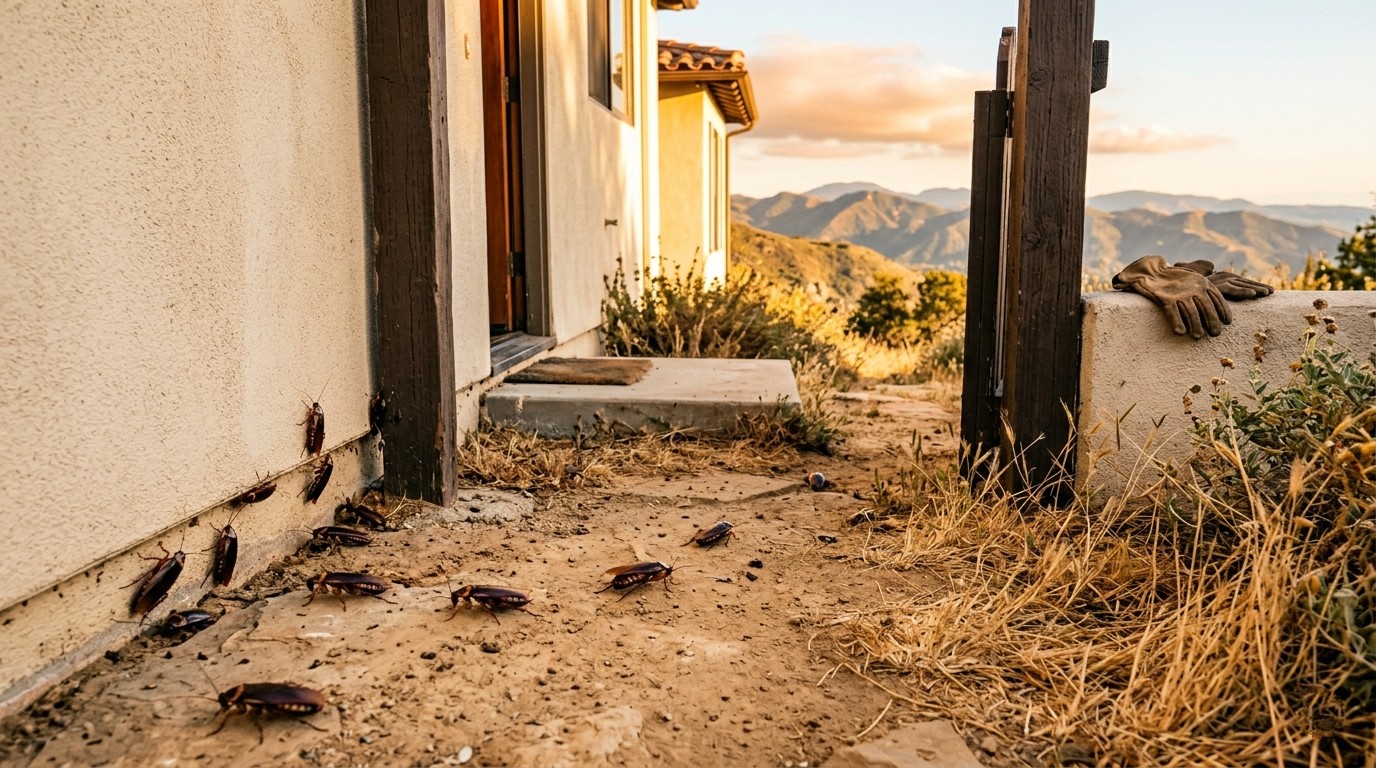
Despite what their name suggests, German cockroaches live exclusively indoors and have no interest in leaving. They're small, fast, and flat — squeezing into gaps that seem impossibly narrow. Adults are roughly half an inch long with two dark parallel stripes behind their head.
½ inch
Adult Size
Small enough to hide behind outlet plates, under appliance seals, and inside cabinet hinges.
30–40
Eggs per case
Females carry the egg case until just before hatching, protecting nearly every offspring.
Weeks
Time to infestation
A small founding population can become a full infestation in just a few months in our warm climate.
They cluster near warmth, moisture, and food: behind refrigerators, under dishwashers, and inside wall voids near plumbing. In multi-unit housing, they spread freely through shared walls and utility chases.
Why they're more than just a nuisance
Allergen production
40–60% of children with asthma in urban areas are sensitive to cockroach allergens. Shed skins, saliva, and droppings become airborne and accumulate in kitchens.
Food contamination
Cockroaches move between unsanitary environments and food prep surfaces constantly, transferring pathogens.
Resistance to common products
Many California cockroach populations have developed resistance to over-the-counter spray treatments, making DIY control increasingly ineffective.
Rapid spread in multi-family buildings
An untreated unit is a constant source of reinfestation for neighboring units — even ones that have been professionally treated.
How we treat it
01
Harborage inspection
We identify exactly where the population is concentrated before applying anything. Spraying blindly drives cockroaches deeper into walls.
02
Gel bait placement
Gel baits placed precisely in harborage zones outperform sprays. Foragers carry the bait back to nymphs and egg-carrying females.
03
Crack and crevice treatment
Applying residual treatments to the specific gaps where cockroaches travel and hide.
04
Follow-up monitoring
At least two follow-up visits to catch newly hatched nymphs from egg cases that survived the initial treatment.
Structural pest
02. Termites
Of all the pests on this list, termites are the most likely to cost you serious money — and the least likely to announce themselves until significant damage is already done. Western subterranean termites are the most widespread across the region.
1M+
Colony Size
Mature colonies can contain over a million workers, all actively feeding around the clock.
Feb–May
Swarm Season
Winged reproductives emerge in spring. Discarded wings near windowsills are a common first sign.
Year-round
Activity Level
SoCal soil temperatures rarely drop low enough to slow termite feeding or movement.
The SoCal risk factors that matter
Wood-frame construction is standard across most of Southern California — exactly what termites are after. Our clay-heavy soils crack as they expand and contract with moisture changes, creating foundation pathways. Add year-round warmth and urban sprawl, and you have a termite environment that rarely gives homeowners a break.
How we treat it
01
Full property inspection
Inspecting foundation, subarea, interior, attic, and exterior for mud tubes, damage, and conducive conditions.
02
Liquid soil treatment or baiting
We apply liquid termiticide to the soil around the foundation perimeter, or install a bait monitoring system.
03
Conducive condition correction
Documenting grading issues, excessive moisture, wood debris, or landscape contact that feeds the problem.
Arachnid
03. Black Widow Spiders
Most spiders in Southern California are completely harmless. But the western black widow (Latrodectus hesperus) is the only spider in our service area that poses a legitimate medical risk. Females are glossy black with a red hourglass marking on the underside of the abdomen.
Neurotoxic
Venom Type
Black widow venom affects the nervous system and can cause severe muscle pain, cramping, and nausea.
Low & Dark
Hiding Spots
Woodpiles, garage corners, meter boxes, under decking, and storage areas are prime black widow territory.
Moderate
Risk Level
Bites are uncommon but serious — especially for children, elderly, and immunocompromised individuals.
A word on other spiders
For the vast majority of spider species in SoCal, the goal is control, not eradication. They eat the insects you don't want. We manage them as part of a general perimeter program.
How we treat it
01
Exterior harborage treatment
Targeted residual treatments to eaves, foundation vents, garage interiors, and fence lines.
02
Web removal
Physical removal of webs and egg sacs at every visit to prevent re-establishment.
03
Habitat reduction recommendations
Advising on woodpile placement, storage practices, and ground cover that reduce harborage opportunities.
Rodent
04. Roof Rats
Roof rats are the dominant rat species along California's coast and throughout its urban neighborhoods. Unlike the heavier Norway rat, roof rats are sleek and agile climbers. They prefer elevated living — tree canopies, attic rafters, and overhead utility lines.
Above
Entry Method
Access via overhanging branches, utility lines, and gaps at the roofline — not from the ground.
½ inch
Gap Needed
That's all a roof rat needs to squeeze through — about the diameter of a quarter.
Nocturnal
Activity Hours
Scratching and scurrying sounds in the attic are most audible in the hour after dark.
Signs of roof rat activity
Droppings
Capsule-shaped, about ½ to ¾ inch long with pointed ends — found in attics, along rafters, or near food storage.
Grease marks
Dark rub marks along beams, rafters, and wall edges where rats travel repeatedly.
Gnaw damage
Chewed wood, PVC pipe, or wiring — especially in the attic or garage.
Nesting material
Shredded insulation, paper, or plant material gathered into a nest in corners or wall cavities.
How we treat it
01
Attic and exterior inspection
Identifying active entry points, travel routes, nesting locations, and the degree of attic contamination.
02
Trapping
Interior snap trapping is the most effective method — and doesn't risk secondary poisoning to neighborhood hawks and owls.
03
Exclusion
Sealing roofline gaps, damaged vents, and utility penetrations using galvanized hardware cloth. This is the step most people skip — and why rat problems come back.
04
Exterior management
Advising on tree trimming and exterior attractants (fruit trees, bird feeders, compost) drawing rats to the property.
Ant species
05. Argentine Ants
The ant that defines pest control in Southern California. They arrived in California in the 1890s and have spent the past 130 years expanding into one of the largest recorded insect supercolonies on Earth — stretching hundreds of miles along the California coast.
Dozens+
Queens per colony
Multiple queens make them nearly impossible to destroy with standard repellent sprays.
None
Inter-colony Aggression
Colonies cooperate rather than compete, forming one unified network across entire neighborhoods.
Year-round
SoCal Presence
Expect indoor pressure during summer heat waves and winter rains — two seasons, not one.
Why DIY backfires on Argentine ants
Contact insecticide sprays kill the workers you see and trigger a stress response that causes the colony to bud and spread. Breaking the cycle requires slow-acting bait that workers carry back and share with the queens. No queens eliminated, no long-term control.
How we treat it
01
Trail and nesting inspection
Tracing active trails to identify foraging routes, entry points, and outdoor nesting areas. Treating inside alone never resolves an Argentine ant problem.
02
Slow-acting bait application
Workers carry it back to queens and reproductives that never come into contact with a spray.
03
Perimeter barrier treatment
A residual exterior zone slows reinfestation pressure from the surrounding supercolony while the bait does its work.
04
Quarterly maintenance
Argentine ant pressure in SoCal is year-round. Ongoing perimeter maintenance is what keeps populations from rebuilding.
Common questions
SoCal Pest FAQs
The questions South Bay homeowners ask us most about the pests on this list.
Q
What is the most common pest in Southern California?
A
Argentine ants are the single most common pest complaint across Southern California, followed by German cockroaches and roof rats. All three stay active year-round thanks to the region's mild climate, though ant pressure spikes during summer heat waves and winter rains.
Q
Why do German cockroaches keep coming back after I spray?
A
Many Southern California cockroach populations have developed resistance to over-the-counter sprays, and sprays rarely reach the tight harborage spaces where roaches actually live and breed. Targeted gel bait placed in those harborage zones — combined with follow-up visits to catch newly hatched nymphs — is far more effective.
Q
How do I know if I have termites?
A
The most common early signs are discarded wings near windowsills (usually February through May), mud tubes on foundation walls, and wood that sounds hollow or looks blistered. Subterranean termites hide their activity well, so a professional inspection is the only reliable way to confirm an infestation before serious damage occurs.
Q
Are black widow spiders dangerous?
A
The western black widow is the only spider in our service area that poses a real medical risk. Bites are uncommon but can cause severe muscle pain and cramping, and are most serious for children, the elderly, and immunocompromised people. They favor low, dark, undisturbed spots like woodpiles, garage corners, and meter boxes.
Q
How do roof rats get into the house?
A
Roof rats enter from above rather than from the ground — through overhanging tree branches, utility lines, and gaps at the roofline. They only need a half-inch opening, about the size of a quarter. Sealing those roofline gaps with galvanized hardware cloth is the step most homeowners skip, which is why rat problems keep coming back.
Related Reading
Go deeper on the pests and services covered in this guide.
- German cockroaches: why they keep coming backHow resistance and hidden harborage make this indoor pest so persistent — and what actually controls it.
- Termite control and inspectionSoil treatment, baiting, and the conducive-condition fixes that protect wood-frame homes.
- Black widow spiders: identification and controlHow to recognize the one medically significant spider in the area, and where it tends to hide.
- Roof rats: signs, entry points, and controlThe agile climber that enters from the roofline — how to spot activity and seal it out.
- Rats in the attic: signs and what to doThe scratching at night is almost always a roof rat — how to confirm it, and why poison backfires.
- Why Argentine ants get worse when you spray themThe supercolony behind SoCal's relentless ant trails, and the bait-based approach that controls it.
- Summer pest season: what to watch forHow these pests surge as the weather warms, and how to get ahead of the season.
- German vs. American cockroaches: which do you have?Telling the two apart — and why each species needs a completely different treatment.
SP
About the Author
Sydney Pardey·Owner, Al & Sons Termite and Pest Control
SPCB Field Representative License No. FR 72134SPCB Company License No. 10102
Sydney Pardey is the owner of Al & Sons Termite and Pest Control, a family-owned pest control company serving the South Bay and greater Los Angeles area since 1960. All content is written from direct operational experience and reviewed against current California Structural Pest Control Board standards.
Our LegacyServing Southern California
Serving Southern California
Since 1960.
Al & Sons is more than a business—it's a family legacy. For over 60 years, we've been local neighbors, committed to serving our community across Southern California with the same integrity and care when the business was started in 1960.
100%
Family Owned
SoCal
Local & Dedicated