Pest ID • May 1, 2026
The Tiny Invaders Taking Over Southern California
Everything you need to know about Argentine ants — and how to stop them from taking over your home.
SP
Sydney Pardey
Owner, Al & Sons Termite and Pest Control
7 min readUpdated June 7, 2026
Argentine AntsPest IDSoCal PestsHome Treatment
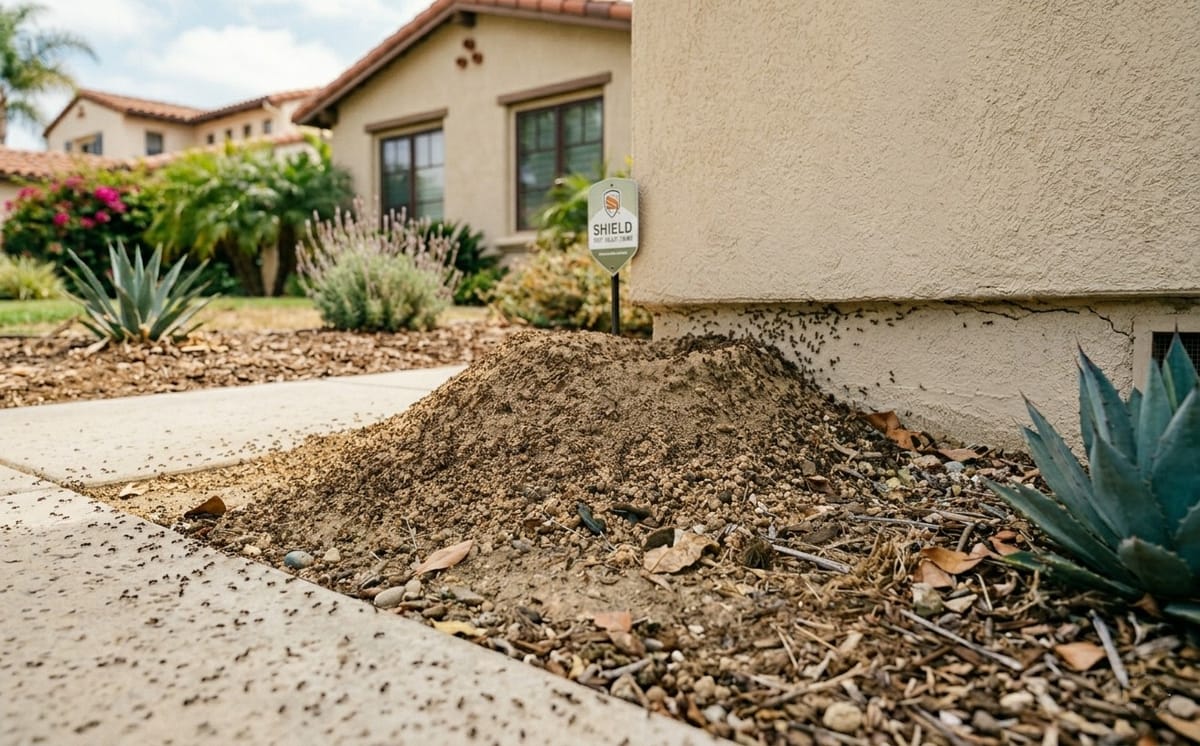
If you've ever watched a trail of tiny brown ants march relentlessly into your kitchen — no matter how many times you spray, wipe, or seal — there's a good chance you're dealing with Argentine ants. And you're far from alone.
Quick Answer
How do you get rid of Argentine ants for good?
Argentine ants can't be controlled with contact sprays, because their colonies contain hundreds of queens and simply split and spread — a behavior called budding — when they're chemically stressed. The only reliable approach is slow-acting bait that foraging workers carry back to the queens, paired with an exterior perimeter treatment and sealing of entry points. Because Southern California's supercolony exerts constant year-round pressure, lasting control depends on ongoing maintenance rather than a single visit.
The Short Version
- Argentine ants are the dominant ant species in Southern California, forming a supercolony that stretches more than 600 miles along the coast.
- Each colony has hundreds of egg-laying queens, so killing the workers you see does nothing to stop the colony.
- Contact sprays make infestations worse by triggering budding — the colony splits into multiple sub-colonies and spreads.
- They invade most heavily during summer heat waves (searching for moisture) and winter rains (escaping flooded outdoor nests).
- Lasting control takes slow-acting bait carried back to the queens, a perimeter barrier, and ongoing follow-up — not a one-time treatment.
What are they?
Meet Linepithema humile — Your Uninvited Houseguest
Argentine ants (Linepithema humile) are a small, light-to-dark brown ant species originally native to South America. They arrived in the United States in the late 1800s, likely hitching a ride on coffee shipments to New Orleans, and have since spread across the Southern United States, California, and beyond.
In Southern California, they are now the dominant ant species — by a wide margin. Workers are typically 1/16 to 1/8 inch long, uniformly brown, and move in long, well-organized trails. Unlike many ants, Argentine ants have a distinct musty, greasy odor when crushed.
What makes them so effective as invaders isn't their size — it's their social structure. A typical Argentine ant colony has not one queen, but dozens to hundreds of queens, all actively laying eggs. This means colonies can grow and split rapidly, and workers from different colonies show no aggression toward each other, forming what scientists call a "supercolony."
Fun facts
By the Numbers
1B+
Colony size
The California supercolony stretches over 600 miles and may contain over a billion individual workers.
100s
Queens per nest
Each colony can have hundreds of egg-laying queens — making them nearly impossible to destroy with standard sprays.
0
Inter-colony aggression
Argentine ant colonies cooperate instead of fight, forming a unified supercolony across entire cities.
2 seasons
Peak invasion times
Expect indoor pressure during summer heat waves (searching for moisture) and winter rains (flooding outdoor nests).
Argentine ants are also known to protect aphids and scale insects from natural predators, essentially "farming" them for the honeydew they secrete. This behavior makes them harmful not just to homes, but to local gardens and agriculture as well.
Why it matters
Why Argentine Ants Are a Growing Problem in SoCal
Argentine ants thrive in California's Mediterranean climate — warm, dry summers and mild, wet winters create the perfect conditions for year-round colony growth. Southern California is ground zero for one of the largest recorded supercolonies on Earth.
Multiple queens
Standard ant killers target queens, but Argentine colonies have hundreds. Kill some, and the colony simply compensates.
Budding behavior
When threatened or disturbed, colonies split and spread — meaning improper treatment can make an infestation significantly worse.
Massive networks
A single structure may be connected to an outdoor supercolony with millions of ants — treating inside alone never solves the problem.
Food flexibility
They'll eat almost anything — sweets, proteins, oils, pet food, and dead insects — making exclusion alone insufficient.
Urban development pressure
As SoCal continues to build, ant colonies get displaced into neighborhoods and homes in higher numbers than ever before.
Our approach
How Al & Sons Treats Argentine Ant Infestations
The most common mistake homeowners make is reaching for a can of spray at the first sight of ants. Contact sprays kill the workers you see — but trigger a stress response in the colony, causing it to scatter and spread. Effective Argentine ant control requires a smarter, more systematic approach.
01
Inspection & Colony Mapping
Our technicians conduct a thorough inspection of your property — inside and out — to identify trails, entry points, nesting sites, and moisture sources. Understanding where the colony is living and traveling is the foundation of an effective treatment plan.
02
Targeted Bait Application
We use slow-acting baits specifically formulated for Argentine ants. Workers carry the bait back to the colony, sharing it with queens and larvae — eliminating the problem at the source rather than just on the surface.
03
Perimeter Treatment
We apply a protective barrier treatment around the foundation, entry points, and key harborage areas. This creates a zone that deters and intercepts ants before they enter your living space.
04
Exclusion Recommendations
Our team identifies physical entry points — gaps in weatherstripping, cracks in foundation, plumbing penetrations, and vegetation touching the structure — that give ants easy access.
05
Follow-Up & Monitoring
Argentine ant control is not a one-visit fix. We schedule follow-up visits to monitor bait uptake, replenish treatments as needed, and ensure the colony population is declining.
A note on DIY treatments
Over-the-counter repellent sprays are the most common reason Argentine ant problems get worse, not better. When colony members detect a chemical threat, they trigger budding — splitting into multiple sub-colonies that spread throughout your home. Professional bait-based programs are the only reliable solution for this species.
Common questions
Argentine Ant FAQs
The questions South Bay homeowners ask us most about Argentine ants.
Q
Why do I have ants even though my house is clean?
A
Argentine ants often come indoors looking for water rather than food, especially as outdoor soil dries out in summer. That's why trails frequently lead to sinks, dishwashers, and bathrooms. A spotless kitchen won't deter them, because the colony outside is responding to moisture and weather — which is why perimeter treatment works better than cleaning alone.
Q
Why do store-bought ant sprays make the problem worse?
A
Contact sprays kill the visible workers but signal a threat to the colony, triggering it to bud — splitting into multiple sub-colonies that scatter to new areas of the home. You end up with more trails in more places. Slow-acting bait does the opposite: workers carry it back and share it with the queens before it takes effect.
Q
Do ant baits from the store work on Argentine ants?
A
Store-bought baits can help a little, but they're often the wrong formulation or placed where ants aren't actively foraging, so uptake is poor. Professional programs match the bait to the season — ants shift between sweet and protein preferences — and place it directly on active trails, which is what drives colony-level results.
Q
How long does it take to get rid of Argentine ants?
A
Because colonies are so large and bait works gradually, meaningful reduction usually takes a few weeks, with follow-up visits to replenish bait and confirm the population is declining. Given the size of the regional supercolony, ongoing quarterly maintenance is what keeps ants from rebuilding.
Q
Will Argentine ants damage my home?
A
They don't cause structural damage the way termites do, but they contaminate food, invade in overwhelming numbers, and "farm" aphids and scale insects that harm garden and landscape plants. The real problem is their relentlessness — without colony-level control, the trails keep returning.
Related Reading
Keep exploring the pests and services behind SoCal's most common ant problem.
- Argentine ants: full species profileIdentification, behavior, and the biology that makes this supercolony so hard to control.
- Our recurring pest control programsMonthly and bi-monthly bait and perimeter service that keeps ant pressure from rebuilding.
- 5 pests that never stop causing problems in Southern CaliforniaWhere Argentine ants rank among the region's most persistent year-round pests.
- Summer pest season: what to watch forWhy ant trails turn relentless in the summer heat — and how to get ahead of them.
SP
About the Author
Sydney Pardey·Owner, Al & Sons Termite and Pest Control
SPCB Field Representative License No. FR 72134SPCB Company License No. 10102
Sydney Pardey is the owner of Al & Sons Termite and Pest Control, a family-owned pest control company serving the South Bay and greater Los Angeles area since 1960. All content is written from direct operational experience and reviewed against current California Structural Pest Control Board standards.
Our LegacyServing Southern California
Serving Southern California
Since 1960.
Al & Sons is more than a business—it's a family legacy. For over 60 years, we've been local neighbors, committed to serving our community across Southern California with the same integrity and care when the business was started in 1960.
100%
Family Owned
SoCal
Local & Dedicated