Pest ID • June 11, 2026
Rats in the Attic — Signs You Have Them and What to Do
The scratching at night isn't your imagination. Here's what's up there, why it matters, and what actually solves the problem in Southern California homes.
SP
Sydney Pardey
Owner, Al & Sons Termite and Pest Control
8 min readUpdated June 11, 2026
RodentsRoof RatsAttic PestsSoCal Homeowner
It usually starts the same way. You're lying in bed at night and you hear it — a faint scratching or scurrying in the ceiling above you. The first time, you tell yourself it's the house settling. The second time, you wonder if it's a possum on the roof. By the third or fourth time, you're up at 2 a.m. with a flashlight, listening at the attic access panel, hoping you're wrong.
You're almost certainly not wrong. Across Southern California — from the South Bay to the Westside, from Pasadena to the San Fernando Valley — roof rats in the attic are one of the most common calls a pest control company gets. The species is established throughout the region, the housing stock provides ideal habitat, and the year-round climate means there's no winter pause in activity. The good news is that roof rats are manageable once you know what to do. The bad news is that almost everything homeowners try first — poison, traps placed in random spots, sealing one obvious gap — either doesn't work or creates worse problems than the rats themselves.
Quick Answer
What are the signs of rats in the attic, and how do I get rid of them?
The signs are scratching or scurrying at night (especially around dusk and dawn), dark droppings about a half-inch long, gnaw marks on wood or wiring, greasy rub marks along beams, and a faint musky odor. In Southern California, the culprit is almost always the roof rat — a climbing species that enters through roofline gaps and attic vents. Effective control requires three steps done by a professional: identify and seal every entry point on the exterior of the structure, trap the rats already inside using snap traps along established travel routes, and address conducive conditions on the property — overhanging tree branches, fruit trees, and accessible outdoor food sources. Poison should never be used inside the structure.
The Short Version
- The species in SoCal attics is almost always Rattus rattus, the roof rat — built to climb and enter through the roofline.
- Night scratching, droppings, gnaw marks, and rub marks are the most reliable signs.
- Poison in the attic is a serious mistake — rats die in walls and create odor problems that last weeks.
- Professional exclusion work — physically sealing every entry point — is the critical step that makes control last.
- Most roof rat entry points are along the roofline, not at ground level.
- Tree branches touching the roof and accessible fruit are the two biggest conducive conditions in SoCal yards.
What's up there
What's Actually Up There
When Southern California homeowners hear "rats in the attic," they sometimes picture the large Norway rat — the species associated with sewers, basements, and ground-level burrows. That's not what's typically in your attic. Norway rats exist in SoCal, but they're heavier, less agile climbers, and tend to stay at ground level.
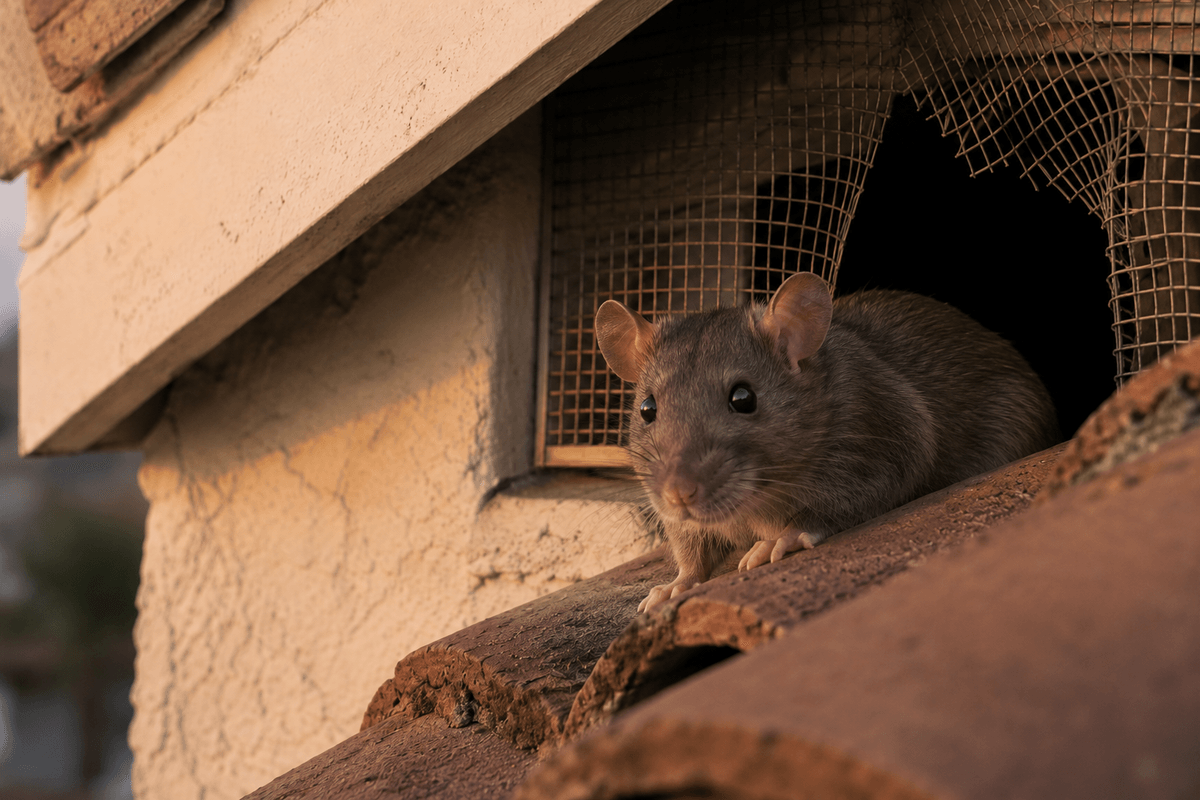
The species in nearly every attic in our region is Rattus rattus, the roof rat — also called the black rat or fruit rat. They're slimmer, lighter, and built specifically to climb. Adults run 12 to 16 inches from nose to tail tip, with the tail typically longer than the body. They're agile enough to run along a power line, scale a stucco wall, climb a fruit tree, and jump from a branch to a roof edge. Once on the roof, they need only a small opening to access the attic — sometimes as little as half an inch.
Roof rats are nocturnal, active primarily from dusk through dawn, which is why you hear them at night. They nest in elevated spaces (attics, palm trees, dense ivy on fences, fruit tree canopies) and travel to food sources at night. A single attic can host one or two rats, or it can host a breeding group of eight to ten — and a breeding group produces five to six litters per year, with five to eight pups per litter. Populations build quickly if left alone.
The seven signs
The Seven Signs
01
Scratching or scurrying at night.
This is what most homeowners notice first. The activity tends to peak just after sunset and again around dawn — both times correspond to roof rats leaving the nest to forage and returning. Daytime sounds are less common but happen with larger populations or when the rats feel undisturbed.
02
Droppings.
Roof rat droppings are dark, smooth, and about a half-inch long with pointed ends — roughly the size of a large grain of rice. You'll typically find them along travel routes: across the tops of attic insulation, on rafters, near nesting areas, and along the edges where the attic floor meets the walls. Fresh droppings are dark and slightly shiny; old droppings are gray and crumbly.
03
Gnaw marks on wood or wiring.
Rats need to gnaw constantly to keep their teeth worn down. In attics, this typically shows up as chewed wood at access points, chewed cardboard storage boxes, and — most concerning — chewed electrical wiring. Roof rat damage to wiring is a documented cause of house fires in Southern California; insurance companies have data on this.
04
Greasy rub marks along beams or framing.
Roof rats follow established travel routes night after night. Over weeks, the oils from their fur leave dark, slightly greasy marks along the surfaces they regularly contact — beams, the edges of openings they squeeze through, and rafter intersections. These rub marks are one of the more reliable indicators of how active the population is.
05
A faint musky odor.
Active rodent populations produce a distinctive musky smell — not strong, but noticeable when you put your head into the attic. It's a combination of urine, droppings, and the rats themselves. A heavy odor usually means a large population or, in some cases, a dead rat somewhere you haven't found yet.
06
Disturbed insulation.
Roof rats burrow into and nest in attic insulation, creating channels, depressions, and visible disturbance across what should be a flat surface. Look for trails through blown-in insulation, compressed areas where rats have been bedding down, and small piles of insulation material moved away from the main layer.
07
Damaged stored items.
Anything stored in the attic — cardboard boxes, fabric, holiday decorations, papers — becomes potential nesting material. Look for chewed corners on boxes, shredded paper or fabric used as bedding, and droppings inside or near stored items. If you have a Christmas decoration storage box that's been chewed open, you know what was in your attic in October.
Why poison backfires
Why "Just Put Out Poison" Is the Wrong Answer
This is the single most common mistake homeowners make with roof rats, and it creates a worse problem than the rats themselves. Here's what happens: you put rodenticide bait blocks in the attic. The rats find them, eat the bait, and feel sick. Sick rats don't behave normally — they retreat to the most hidden, inaccessible nesting spot they can find, often inside wall voids or under insulation in the deepest corner of the attic. Then they die.
A dead rat in an inaccessible wall void smells. For weeks, depending on temperature, body size, and how well-ventilated the space is. There's no way to deodorize around it. You either tear open the wall to remove the carcass — which is expensive and not always possible without knowing the exact location — or you wait it out. Most homeowners pick the latter and then call us asking for help.
There's also a secondary issue: rodenticides are a documented cause of poisoning in pets and in non-target wildlife (coyotes, owls, hawks) that scavenge dead rats. California has tightened restrictions on consumer rodenticides for exactly this reason. Effective rodent control in residential structures essentially never uses poison in the structure itself.
What you can do now
What You Can Do Right Now
While you're arranging professional service, there are meaningful steps you can take immediately that reduce the pressure on your home and make the professional work more effective.
Homeowner actions while you wait for service
Stop the food supply outdoors Pick up fallen fruit from citrus, avocado, and other fruit trees promptly — don't let it sit on the ground. Bring outdoor pet food inside before dark. If you have bird feeders, bring them in at night or switch to a style that doesn't allow seeds to fall to the ground. Secure open trash and recycling bins.
Trim tree branches away from the roof Any branch that touches or hangs over your roof is a rat highway. Trim branches back to at least four feet of clearance from the roofline. This is the single most impactful thing a homeowner can do while waiting for a professional.
Eliminate outdoor harborage Dense ivy growing on fences or walls is prime rat nesting habitat — consider removing or significantly thinning it near the structure. Woodpiles stacked against exterior walls provide both food and shelter; move them away from the house. Clear debris piles and leaf accumulations against exterior walls.
Don't put out poison Rats die in walls and create odor problems that are often worse than the original infestation. If you've already put out rodenticide, remove it before the professional arrives.
Note where you hear the activity Pay attention to the specific ceiling area where you hear scratching — which room, which part of the room, whether it's more toward one side of the house. This information helps the technician prioritize the attic inspection.
What professionals do
What Professional Rodent Control Involves
Roof rat control done properly is multi-step work that requires specialized equipment and roof access. Here's what that actually looks like:
01
A thorough inspection — including the roof.
The technician puts a ladder up and physically walks the roofline, checking every attic vent, every roof-to-wall intersection, every plumbing and electrical penetration through the roof, every fascia board, and every tile intersection. Entry points are almost never visible from the ground — they're typically small gaps in vent screens, deteriorated boot seals around plumbing pipes, gaps where flashing meets the wall, or spaces behind rafter tails. The attic is inspected from inside as well — looking for droppings, rub marks, nesting material, disturbed insulation, and any interior opening to the outside.
02
Sealing every entry point with rodent-proof materials.
This is the most important step and the one that makes control last. Every identified entry point gets sealed with materials rats can't chew through: galvanized hardware cloth for vents and larger gaps, sheet metal flashing for irregular openings, copper wool or steel wool packed into smaller cracks before being sealed. Foam alone, caulk alone, and wood filler are not adequate — rats chew through all of them in days.
03
Snap trap placement along established travel routes.
Once the structure is sealed, the rats already inside need to be removed. Snap traps are placed in the attic along the exact routes the rats are using — identified from the rub marks and dropping concentrations observed during inspection. Traps are baited with peanut butter or dried fruit and placed perpendicular to beams and walls where rats travel.
04
Scheduled follow-up visits.
Trapping continues with regular follow-up visits to remove catches, rebait, and monitor activity. If catches continue beyond what's expected, the technician re-inspects for a missed entry point — continuing catches after what should be a sealed structure almost always means something wasn't found the first time.
05
Final verification.
Once traps have been empty and nighttime activity sounds have stopped, the technician confirms the population is cleared before the active service phase closes.
06
Cleanup and remediation if needed.
For larger or longer-standing infestations, contaminated insulation needs to be removed and replaced, and exposed framing needs to be treated with an enzyme-based cleaner that neutralizes pathogens. This is particularly important because rodent waste in attic insulation serves as a chemical signal that attracts new rats — cleaning removes that signal as part of preventing reinfestation.
07
Assessment of property-level conducive conditions.
A good technician notes what on the property is drawing rats in — specific trees, outdoor food sources, dense vegetation — and communicates those findings. Addressing these conditions alongside the structural work is what prevents recurrence.
Hearing scratching in the attic?
Al & Sons has been handling roof rat exclusion across the South Bay and greater Los Angeles since 1960. We do the actual roof work — walking the roofline, sealing entry points with hardware cloth and metal flashing, setting traps along established travel routes — not just an inspection with recommendations. If something's moving in your attic at night, we're happy to come take a look and tell you what's involved in solving it.
Common questions
Roof Rat FAQs
Common questions from Southern California homeowners about rats in the attic.
Q
How do I know if it's rats or something else in my attic?
A
Roof rats are nocturnal and produce scratching or quick scurrying sounds, primarily right after dusk and before dawn. Possums are larger and produce slower, heavier movement — more thumping than scurrying. Raccoons are loud, often during daytime as well as night, and can sound like a person walking. Squirrels are primarily daytime active, often noisy in the morning. Bats are nearly silent in movement but you may hear faint chittering, particularly at dusk when they leave to feed. If you're not sure, the dropping shape and size is the most reliable confirmation — half-inch with pointed ends is roof rat.
Q
Will roof rats leave on their own if I just wait?
A
No. Once they've established a nest in your attic, they have what they need — shelter, warmth, security, and proximity to food sources outside. They have no reason to leave. Populations grow over time rather than dispersing, and the damage (gnawing on wires, accumulating droppings, insulation destruction) continues until the rats are removed.
Q
Are rats in the attic dangerous to my health?
A
They can be. Rodent droppings, urine, and the ectoparasites rats carry (fleas, mites) are vectors for several diseases — hantavirus, leptospirosis, salmonellosis among them. The risk to occupants in a typical residential attic infestation is generally low but not zero, and rises significantly during cleanup if it's done without proper precautions. Wear an N95 mask and gloves if you're inspecting an attic with rodent activity, and don't dry-sweep droppings — dampen the area first.
Q
How long does it take to get rid of rats in the attic?
A
It depends on the home — the number of entry points, the size of the infestation, and whether any cleanup or remediation is needed all affect the timeline. The process moves in stages: exclusion first, then trapping until the existing population is cleared, then a verification period to confirm no new activity. Anyone promising a "same-day rat solution" is selling something other than a real fix — the work takes the time it takes to do correctly.
Q
Why do roof rats keep coming back even after the attic is treated?
A
Almost always one of two reasons: either there's an entry point that wasn't found during the exclusion work — extremely common because most are in places that require ladder access to inspect — or the conducive conditions on the property are still actively drawing new rats from the neighborhood. Overhanging trees, fruit, outdoor food, and open trash all function as ongoing attractants. Exclusion that seals the structure plus removal of outdoor attractants gives durable results; exclusion alone, without addressing what's drawing rats to the property in the first place, often sees activity resume.
Related Reading
- Roof rat exterminator — what to expect from professional rodent controlOnce you've confirmed roof rats, here's what a thorough professional service actually involves.
- 5 pests that never stop causing problems in Southern CaliforniaThe year-round pests every SoCal homeowner should know.
- Summer is coming — and so are the bugsThe full SoCal summer pest season guide.
- Our rodent control serviceHow exclusion and trapping work in practice.
- Roof rat pest libraryIdentification, behavior, and lifecycle.
- Rodents pest libraryThe broader rodent category for SoCal homeowners.
- Why are there rats in Southern California suddenly?The regional population boom driving more rats into more homes.
SP
About the Author
Sydney Pardey·Owner, Al & Sons Termite and Pest Control
SPCB Field Representative License No. FR 72134SPCB Company License No. 10102
Sydney Pardey is the owner of Al & Sons Termite and Pest Control, a family-owned pest control company serving the South Bay and greater Los Angeles area since 1960. All content is written from direct operational experience and reviewed against current California Structural Pest Control Board standards.
Our LegacyServing Southern California
Serving Southern California
Since 1960.
Al & Sons is more than a business—it's a family legacy. For over 60 years, we've been local neighbors, committed to serving our community across Southern California with the same integrity and care when the business was started in 1960.
100%
Family Owned
SoCal
Local & Dedicated