Service Guide • June 15, 2026
Roof Rat Exterminator — What to Expect From Professional Rodent Control
A step-by-step guide to what actually happens when you hire a professional for roof rats in your Southern California home — and what separates good service from a quick spray-and-go visit.
SP
Sydney Pardey
Owner, Al & Sons Termite and Pest Control
8 min readUpdated June 15, 2026
RodentsRoof RatsProfessional ServiceSoCal Homeowner
If you've decided to bring in professional help for roof rats, the next obvious question is what that actually looks like. Some homeowners call expecting one visit that solves everything. Others picture an aggressive chemical treatment they're nervous about. The reality is different from both — and considerably less mysterious. Good roof rat work in a Southern California home follows a predictable sequence, and understanding what each step accomplishes helps you tell the difference between a thorough service and one that's going to leave you with rats again next year.
This guide walks through what to expect from start to finish — the inspection, the exclusion work, the trapping phase, the follow-ups, the cleanup, and what should be in the final documentation.
Quick Answer
What does professional roof rat extermination involve in Southern California?
A complete roof rat service is a multi-visit process: (1) initial inspection of the roofline, attic, and exterior to identify entry points and population indicators; (2) exclusion work — physically sealing every identified entry point with rodent-proof materials like hardware cloth and metal flashing; (3) trapping inside the structure using snap traps along established travel routes (not poison); (4) scheduled follow-up visits to clear remaining rats and verify no new activity; (5) cleanup of contaminated areas if needed, and recommendations for conducive conditions on the property. Any service that promises a "one-visit fix" is selling something other than real roof rat control.
The Short Version
- Real roof rat work is multi-visit — a one-and-done service almost always misses something.
- The initial inspection covers the roofline, attic, and exterior — not just the inside.
- Sealing entry points (exclusion) happens before trapping, not after.
- Poison should never be used inside structures — snap traps along travel routes are the right tool.
- Follow-up visits matter as much as the initial work.
- Final documentation should list every entry point sealed and conducive conditions to address.
The inspection
Step 1 — The Initial Inspection
The first visit is the most important one, and how long it takes is the first indicator of service quality. A proper inspection of a typical Southern California single-family home takes 45 minutes to an hour and a half — sometimes longer for larger or multi-story homes. If a technician shows up, glances around for ten minutes, and starts giving you a quote, the inspection isn't thorough enough to identify the actual problem.
A good inspection covers four areas:
The roofline.
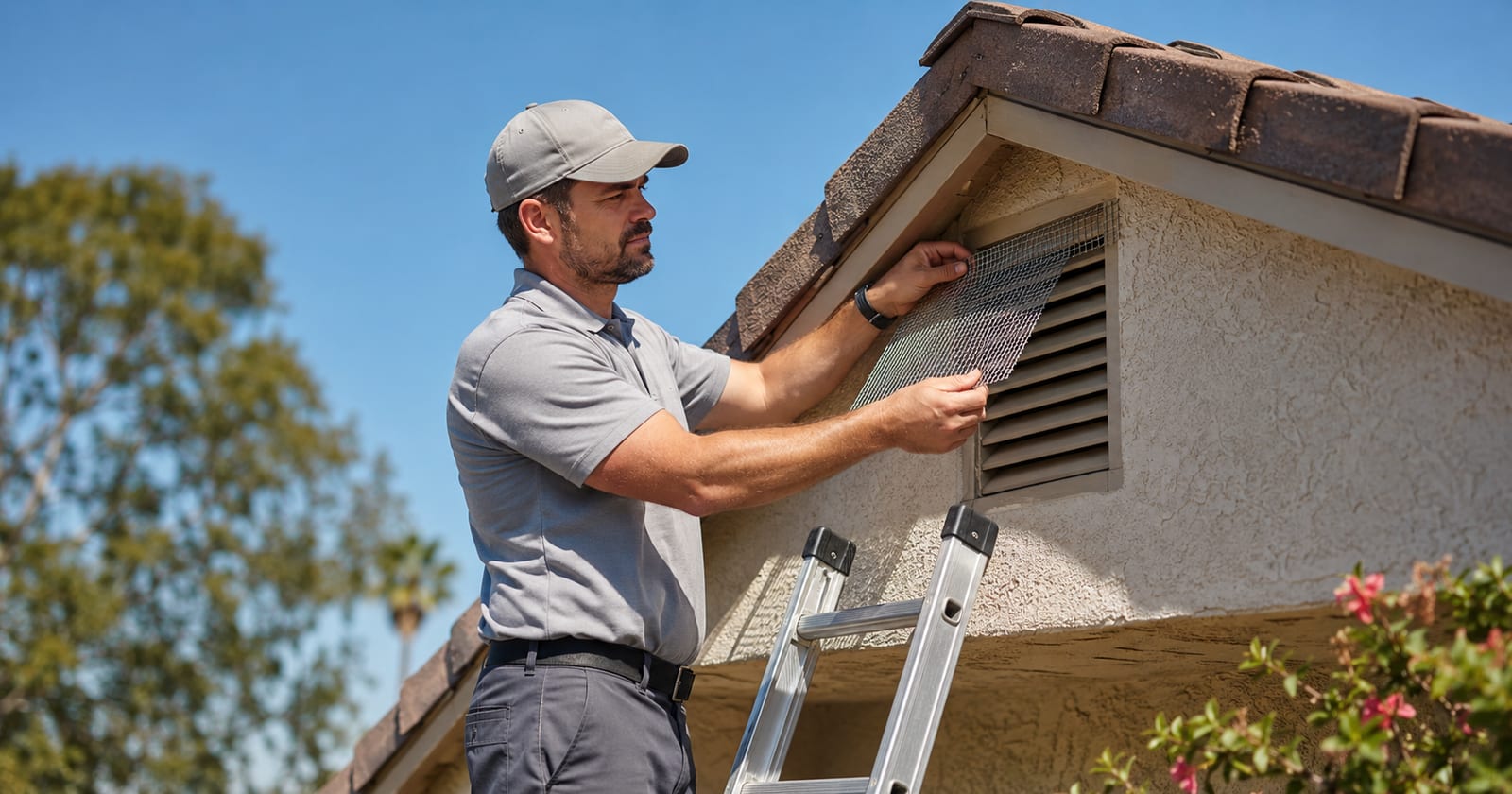
This is where roof rats actually enter, and it can't be inspected from the ground. The technician should put a ladder up and physically check the roof — looking at every attic vent, dormer vent, soffit vent, and gable vent for damaged screens; checking roof-to-wall intersections for gaps in flashing; examining plumbing and electrical penetrations for damaged boot seals; inspecting fascia boards for rot or pulling away from the structure; and looking at any tile-roof intersections for gaps where bird-stops have failed.
The attic.
The technician should enter the attic with a flashlight and look for indicators of an active infestation: droppings (concentration and freshness), rub marks along beams and at openings, gnaw marks on wood or wiring, disturbed insulation, nest material, and any visible openings to the outside. The attic inspection often reveals entry points not obvious from the roof side — light visible through a gap in daytime is direct evidence of an opening.
The exterior.
A walk around the structure to check garage door seals, exterior door sweeps, dryer and exhaust vents, weep holes, foundation penetrations, and utility connections. Roof rats sometimes enter through the lower structure too, especially on multi-level homes where lower-level openings give access to wall voids that connect to attics.
The property.
What's drawing rats to your home in the first place? Overhanging tree branches within four feet of the roofline, fruit trees with mature fruit, dense ivy or bougainvillea on walls, outdoor pet food, open trash and recycling, bird feeders, exposed compost. These conducive conditions are part of the problem and need to be addressed alongside the structural fix.
At the end of the inspection, you should get a clear summary: what entry points were identified and where, what conducive conditions are contributing, and what the proposed treatment plan looks like. Estimates given without an attic inspection or roof inspection are essentially guesses.
Exclusion
Step 2 — Exclusion (the Single Most Important Step)
Exclusion means physically sealing every identified entry point with materials rats can't chew through. The goal is to make the structure rat-tight before any trapping begins — otherwise you're trapping individual rats while new ones replace them through unsealed openings.
The right materials matter. Roof rats can chew through expanding foam, caulk, plastic, wood filler, and most weatherstripping in days. Effective exclusion uses steel and metal materials:
1/4-inch galvanized hardware cloth
For vents, attic openings, and larger gaps. The mesh size matters — anything larger than 1/4 inch lets juvenile rats through, and finer mesh clogs with debris.
Sheet metal or aluminum flashing
For irregular openings, gaps between flashing and structure, or damaged eave repairs.
Copper wool or steel wool
Packed into smaller cracks before being sealed with mortar, caulk, or expanding foam. The steel is the actual barrier; the sealant holds it in place.
Replacement vent covers
With integrated rodent guards for damaged or undersized original vents.
Door sweeps and threshold seals
For garage doors and exterior doors with worn or missing seals.
The exclusion work involves real labor — ladder work on the roof, fitting and cutting hardware cloth, drilling pilot holes, screwing in repairs, applying flashing where needed. If a technician quotes you a "rodent control" service that doesn't include significant physical sealing work, the exclusion piece isn't happening — they're just going to set traps and hope.
Trapping
Step 3 — Trapping the Existing Population
Once the structure is sealed, the rats already inside need to be removed. The right tool is snap traps placed along established travel routes inside the attic — not poison, not glue boards, not live-catch traps.
Why snap traps and not poison: rodenticides applied inside a structure cause rats to die in inaccessible wall voids, where they decompose and create odor problems that can last weeks. Snap traps kill the rat immediately and keep the body recoverable.
Why not glue boards: glue boards trap rats alive and slowly, creating both humane concerns and practical problems — rats can pull free or chew their way off, and they still die in inaccessible spots before being found.
Why not live-catch traps: relocating rodents is illegal in California under fish and wildlife regulations, and even if it weren't, relocated rats die quickly from territorial conflicts in their new location or find their way back. Catch-and-release isn't a humane solution — it's a slower lethal one.
A proper trap placement uses multiple snap traps in a typical attic — far more than most homeowners would use on their own. Placement matters: traps go perpendicular to walls, beams, and travel routes (with the trigger end toward the wall), placed exactly where rub marks and droppings indicate the rats actually travel. Traps are baited with peanut butter or dried fruit.
Follow-ups and verification
Step 4 — Follow-Up Visits and Verification
After the initial inspection, exclusion, and trap placement, there should be scheduled follow-up visits during the active trapping phase, then one or two verification visits afterward.
What happens during follow-ups:
Trap checks and rebaiting
Catches are counted and removed, traps are rebaited and repositioned if needed based on activity patterns.
Verification of seal integrity
Sometimes a sealed entry point gets damaged by weather, animals, or settling. Follow-up visits check that exclusion work is holding.
Reassessment of activity
Are new droppings appearing in different locations than before? That can indicate shifted travel routes — or an unsealed entry point producing new arrivals.
Adjustments to the plan
If catches are continuing beyond what's expected, the technician should re-inspect for missed entry points, not just leave the traps in place.
A "one-visit rodent treatment" is almost always inadequate. The technician can't verify the work is holding without coming back. Services that bill once and disappear are billing for trap setup, not for actual rodent control.
The final verification visit happens when traps have been empty and no new activity indicators have appeared. At that point, the active service phase is complete.
Cleanup
Step 5 — Cleanup and Remediation
After the rats are gone, what they left behind needs to be addressed. This step varies by service — some pest control companies include it, some refer it out to remediation specialists, some leave it to the homeowner.
For a small infestation, cleanup may be minimal — spot removal of droppings, surface treatment of the affected area. For a heavy or long-standing infestation, contaminated insulation (areas heavily soiled with droppings, urine, or nesting material) is typically removed and replaced. Exposed framing and floor surfaces are cleaned and treated with an enzyme-based cleaner that neutralizes pathogens.
Why this matters: rodent waste in attic insulation carries leptospirosis, hantavirus, salmonella, and other pathogens. Heavy contamination also serves as a chemical signal that attracts new rats — urinary trails left by previous occupants tell other rats this is established habitat. Cleanup isn't cosmetic; it's part of preventing reinfestation.
Documentation
What Should Be in the Documentation
At the end of a properly run roof rat service, you should receive written documentation that includes:
A list of every entry point identified and sealed
With locations specific enough that you could verify the work yourself — e.g., "northeast corner gable vent, hardware cloth installed behind grille" — not just "vents sealed."
A diagram or written description of trap locations
So you know where they were placed and can monitor for any new activity.
A list of conducive conditions identified on the property
Overhanging branches, fruit trees, outdoor food sources — with recommendations for addressing each.
Trap catch counts from each visit
So you have a clear picture of how the trapping phase went.
Any cleanup work performed
And any further remediation recommended.
This documentation isn't just for your records. It's what you reference if rats appear again later — the technician can compare new activity against the previous map and identify whether something new is happening or a previously sealed point has failed. Services that hand you a one-line invoice and nothing else are setting you up to start from scratch if there's a recurrence.
What to ask
What to Ask Before Hiring a Roof Rat Service
"Will you do an attic inspection?"
If the answer is no, or if it's only "if necessary," move on. Roof rats live in attics and an inspection without going in is incomplete.
"How will you find the entry points on the roof?"
The answer should involve a ladder and physical inspection of the roofline, not "we'll seal anything obvious."
"What materials do you use for exclusion?"
Hardware cloth, sheet metal, copper or steel wool — these are the right answers. "Expanding foam" or "caulk" alone is not.
"How many follow-up visits are included?"
A complete service has scheduled follow-ups, not just an as-needed callback policy.
"Do you use poison in the attic?"
The answer should be no. If the answer is yes, ask why — and be cautious. This is the dead-rat-in-the-wall scenario that creates worse problems than the original infestation.
Need a proper roof rat assessment?
Al & Sons has been handling roof rat exclusion across the South Bay and greater Los Angeles since 1960. Our process is the one described in this article — thorough inspection, real exclusion work with proper materials, snap-trap-based removal (no poison in structures), scheduled follow-ups, and complete documentation. If something's moving in your attic, we'd be happy to come out, take a proper look, and walk you through exactly what the fix involves.
Common questions
Professional Rodent Control FAQs
Common questions from Southern California homeowners about hiring a roof rat exterminator.
Q
Why does it take multiple visits? Can't they just put out traps and be done?
A
Putting out traps without exclusion catches the current rats but does nothing about new rats entering through the same openings. The infestation continues. Real roof rat control requires sealing the structure first, then removing the trapped population — and verifying both worked before declaring the job done. Services that promise faster timelines are skipping steps.
Q
How much does a professional roof rat service cost?
A
It varies significantly with the home and the extent of work needed. The main factors are the number of entry points, the size of the home, how much remediation the attic needs, and whether the service includes scheduled follow-ups. We don't quote sight-unseen because the inspection genuinely determines the scope. What to watch for: services that quote a single low number without an inspection are usually planning to upsell aggressively after the fact, or they're going to do less work than the home actually needs.
Q
Will the service include cleaning up the droppings and damaged insulation?
A
It depends on the service. Some companies include cleanup in the standard package; some treat it as a separate service; some refer it out to remediation specialists. Ask before signing — and ask what "cleanup" includes specifically. Spot removal of visible droppings is different from removing and replacing contaminated insulation. For heavy infestations, full insulation replacement may be warranted and is typically a meaningful cost on top of the pest control work.
Q
How long does the full roof rat process take, from start to finish?
A
Most jobs run a few weeks from the first visit to a verified finish, though it genuinely varies with the home — how many entry points there are, how large the infestation is, and whether the attic needs cleanup or insulation replacement. Expect a staged timeline rather than a single fix: the exclusion work goes in first, trapping runs until the existing population is cleared, and a verification window follows to confirm nothing new is getting in. If a company quotes a "same-day" rat job, they're pricing trap placement — not a finished result.
Q
Why do roof rats keep coming back even after professional treatment?
A
It almost always traces back to one of two gaps in the original work. Either an entry point was missed during exclusion — easy to do, since the ones that matter are usually up on the roofline where a ladder is needed to reach them — or the property itself is still drawing rats in: overhanging branches, dropped fruit, accessible pet food, and open trash keep pulling fresh arrivals from the neighborhood. A service that both seals the structure and flags those outdoor attractants for you is what makes the result hold. Sealing alone, with the attractants left in place, is the usual reason activity resumes a season later.
Related Reading
- Rats in the attic — signs you have them and what to doIdentification and the underlying problem.
- Why isn't my pest control working? 7 reasons treatments failWhy misdiagnosis and shortcut services fail.
- 5 pests that never stop causing problems in Southern CaliforniaThe year-round pests every SoCal homeowner should know.
- Our rodent control serviceRecurring service for ongoing rodent pressure.
- Roof rat pest libraryIdentification, behavior, and lifecycle.
SP
About the Author
Sydney Pardey·Owner, Al & Sons Termite and Pest Control
SPCB Field Representative License No. FR 72134SPCB Company License No. 10102
Sydney Pardey is the owner of Al & Sons Termite and Pest Control, a family-owned pest control company serving the South Bay and greater Los Angeles area since 1960. All content is written from direct operational experience and reviewed against current California Structural Pest Control Board standards.
Our LegacyServing Southern California
Serving Southern California
Since 1960.
Al & Sons is more than a business—it's a family legacy. For over 60 years, we've been local neighbors, committed to serving our community across Southern California with the same integrity and care when the business was started in 1960.
100%
Family Owned
SoCal
Local & Dedicated