Pest ID • May 30, 2026
7 Signs You Have Termites — and What Each One Means
How to read the warning signs Southern California homes show before serious damage sets in.
SP
Sydney Pardey
Owner, Al & Sons Termite and Pest Control
8 min readUpdated May 30, 2026
TermitesPest IDHome InspectionSoCal Homeowner
Termites are responsible for an estimated $5 billion in structural damage across the United States every year. The majority of that cost is not covered by standard homeowner's insurance. And in Southern California — where two active termite species operate year-round in our mild climate, where wood-frame construction is the standard, and where Los Angeles consistently ranks among the highest-risk metro areas in the country for termite activity — the question for most homeowners isn't really whether they'll encounter termites, but when, and whether they'll catch it early enough to matter.
The challenge is that termites are genuinely difficult to detect. Unlike a cockroach on the kitchen counter or a wasp nest under the eave, termite activity is almost entirely hidden. They feed from the inside of wood outward, working for months or years inside walls, floors, and structural members before producing any visible evidence at the surface.
Quick Answer
How do I know if I have termites in my Southern California home?
Seven signs point to termite activity: discarded wings near windows, frass (small piles of pellets that look like sand or pepper), mud tubes on foundation walls, hollow-sounding wood, doors or windows that suddenly stick, small round kick-out holes in wood, and live swarmers inside the home. In SoCal, drywood termites swarm September through November and leave frass; subterranean termites swarm in spring after rain and build mud tubes. By the time any of these signs appear, the colony has typically been feeding for at least two to five years.
The Short Version
- SoCal homes face two active species year-round: drywood and subterranean termites.
- Drywood termites leave frass (pellet droppings) and kick-out holes — no soil contact needed.
- Subterranean termites build mud tubes between soil and wood — moisture-dependent.
- Discarded wings near windows or light fixtures mean a mature colony is nearby.
- Hollow-sounding wood, sticking doors, and indoor swarmers all signal advanced infestation.
- Catching termites at the frass stage is dramatically cheaper than catching them at the structural-damage stage.
Know your termite first
Two Species, Two Very Different Sets of Signs
Southern California is home to two primary termite species, and the signs they leave behind are different. Knowing which one you're dealing with matters because treatment approaches differ significantly between them.
Drywood
Most common in SoCal
Live entirely within the wood they infest. No soil contact required. Slow-moving and quiet. Can go undetected for years.
Subterranean
Present throughout LA County
Live in underground colonies and access wood through soil contact or mud tubes. Mature colonies number in the hundreds of thousands and feed continuously, year-round.
2–5 yrs
Colony age before swarming
A colony must be at least two to five years old before it produces swarmers. Seeing swarmers means an established colony has been feeding for years.
Both
Many SoCal homes have
It's not uncommon for Southern California homes to have both drywood and subterranean termite activity simultaneously in different areas of the structure.
Sign 1
Discarded Wings Near Windows, Doors, or Light Sources
Small, uniform, translucent wings — found in clusters near windowsills, sliding door tracks, exterior vents, or around indoor light fixtures. They're typically only a few millimeters long and may be scattered or piled. You've witnessed — or missed — a termite swarm. Swarming is how termite colonies reproduce: mature colonies send out winged reproductives to establish new colonies. Swarmers themselves don't cause structural damage. What they signal is that a mature, established colony is present nearby — because colonies must be at least two to five years old before they produce swarmers.
In Southern California, subterranean termites typically swarm in spring following rain events, when daytime temperatures rise and humidity increases. Drywood termites swarm later — most commonly September through November in coastal areas. Finding discarded wings confirms an existing mature colony that has already been feeding for years, not days.
Termite swarmers vs. flying ants
These are commonly confused. Termite swarmers have straight antennae, equal-length wings, and a straight body without a pinched waist. Flying ants have elbowed antennae, wings of unequal length, and a distinctly pinched waist. The distinction matters — if you're not sure what you found, save a sample and have someone take a look.
Sign 2
Frass: Termite Droppings That Look Like Sand or Pepper
Small piles of what appears to be fine sand, sawdust, or ground pepper on horizontal surfaces — window ledges, floors, furniture, baseboards. Under magnification, individual pellets are oval-shaped with six flattened sides and ridges running lengthwise. The color ranges from light tan to dark brown depending on the wood being consumed.
This is a drywood termite sign specifically. Unlike subterranean termites, which use their waste to construct mud tubes, drywood termites push their fecal pellets out of small kick-out holes — openings less than 2mm in diameter — to eject waste from their tunnels. The pile will keep reappearing after you sweep it away if the colony is still active. Sweep it, mark the date and location, and check back in 48 hours. If it's returned, the colony is actively feeding. Look near baseboards, below wooden window frames, along the tops of door frames, near attic access panels, and on any horizontal surface below exposed wooden structural members.
Sign 3
Mud Tubes on Foundation Walls, Piers, or Exposed Surfaces
Narrow, pencil-width tubes of dried mud running along foundation walls, concrete piers, wooden posts, or across any exposed surface between the soil and wooden structural members. They're typically the color of the surrounding soil and can run vertically, horizontally, or at angles across whatever surface provides a path.
This is a subterranean termite sign specifically. Subterranean termites need moisture to survive and cannot tolerate exposure to open air. Mud tubes are how they travel between their underground colony and the wood they're feeding on — maintaining the temperature and humidity conditions they require.
Where to look.
Along the exterior foundation, inside the subarea or crawl space if accessible, on concrete piers, on the interior side of foundation walls in garages, and along any wooden post that contacts the soil or concrete.
Active vs. inactive.
Break a section of a mud tube and check back in a few days. If it's been repaired, the colony is active. If it hasn't, the tube may be abandoned — though abandoned tubes still indicate a past infestation that should be inspected professionally.
Sign 4
Hollow-Sounding or Visibly Damaged Wood
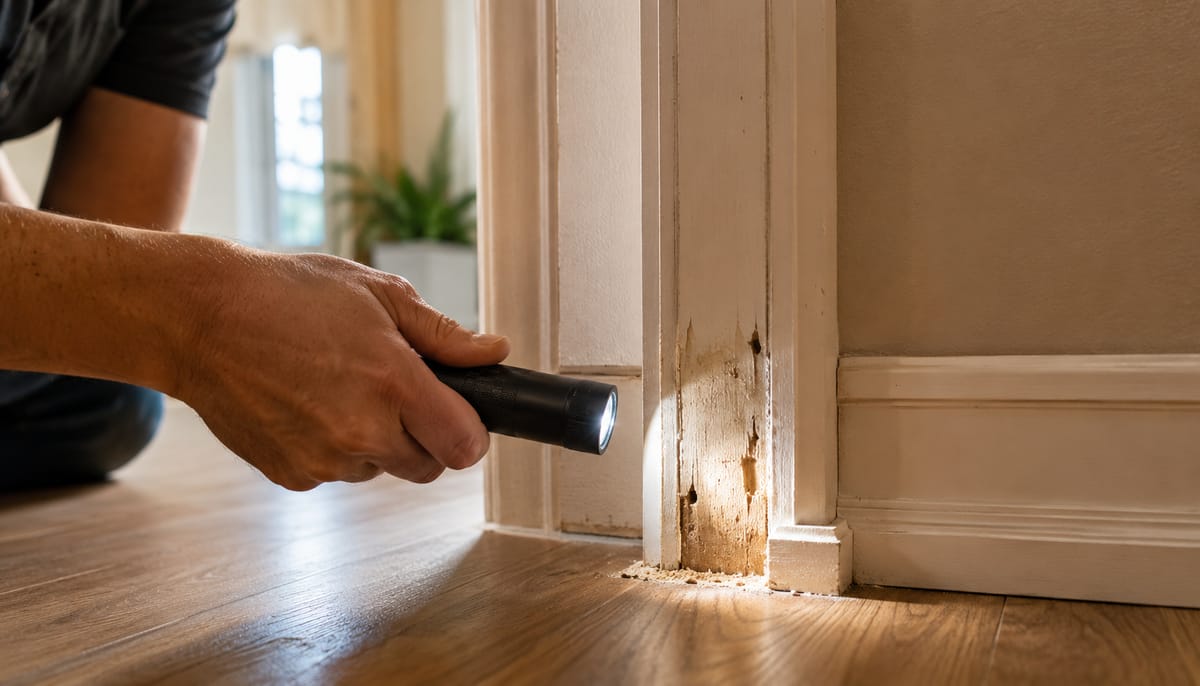
When you tap on wood that has been termite-damaged — baseboards, door frames, structural posts, window sills, floor joists — it produces a hollow, papery sound rather than the solid thud of intact wood. In more advanced cases, the surface may appear blistered, buckled, or slightly sunken. Pressing a screwdriver into damaged wood meets less resistance than it should.
Termites consume wood from the inside outward, leaving a thin shell that maintains an appearance of structural integrity at the surface while the interior is largely gone. This sign appears with both drywood and subterranean termites, and it generally indicates a more advanced infestation — the colony has been present long enough to hollow out meaningful portions of structural members. Systematically tap along baseboards, door frames, window frames, any exposed wooden beams or posts, and subflooring near exterior walls. Pay particular attention to areas with a history of moisture.
Sign 5
Doors and Windows That Suddenly Stick
Interior doors or windows that previously opened and closed smoothly begin to stick, bind, or require more effort to operate. Paint around door or window frames may show fine cracking or bubbling. This can appear suddenly, without any obvious cause like rain or seasonal humidity changes.
This is one of the most commonly misdiagnosed termite signs because homeowners attribute it to settling, humidity, or paint issues. When termites consume the wood inside door and window frames, the structural integrity of those members changes — they warp slightly, shift, and no longer hold their original alignment. Paint that bubbles or separates from wood near a frame without a nearby moisture source is another manifestation: termites working just below the surface cause the wood to expand and the paint to deform. When this appears alongside other signs on this list, or in a home with no recent moisture history in the affected areas, it warrants investigation.
Sign 6
Small Round Holes in Wood Surfaces
Tiny, clean-edged circular or oval holes — typically less than 2mm in diameter — appearing on wooden surfaces: baseboards, door frames, window sills, exposed beams, wooden furniture, or attic framing. They may appear singly or in clusters. There may or may not be frass visible below them.
These are kick-out holes — the openings drywood termites create to eject frass from their tunnel system. Finding them without visible frass below doesn't mean the colony is inactive. Frass may have been swept away, or the holes may be on a vertical surface where it falls and scatters. The holes themselves are a direct indicator of drywood termite tunneling inside that piece of wood, and they help identify exactly where a targeted inspection should focus.
Sign 7
Swarmers Appearing Inside the Home
Live, winged insects — dark brown to black, roughly half an inch long, with two equal-length pairs of wings — appearing suddenly inside the home, typically near windows, light fixtures, or exterior doors. A swarm event can involve dozens to hundreds of these insects appearing within a short window of time, often on a warm afternoon following rain.
Finding swarmers outside near your home is concerning. Finding them inside is more so. Swarmers appearing from within walls, from attic spaces, or from floor-level gaps indicate that the colony producing them is located within the structure itself — not just nearby. This is among the most urgent signs on this list and should prompt immediate professional inspection.
Your immediate action plan
Don't treat it yourself Over-the-counter termite products can drive colonies deeper into the structure, scatter activity, and complicate professional treatment — often without meaningfully reducing the colony. For drywood termites especially, the extent of an infestation inside a wall or floor system is impossible to assess from the surface.
Document what you found and where Take a photo. Note the location, the date, and whether it was inside or outside. This information helps a technician prioritize where to inspect and what they're likely looking for. Save any frass or discarded wings in a small bag or container.
Get a professional inspection promptly A thorough inspection of a SoCal home covers the subarea (if accessible), foundation, exterior, interior, and attic — looking for damage, mud tubes, frass, kick-out holes, swarmers, and conducive conditions. The report will identify active infestations, evidence of prior infestation, and conditions that make the property vulnerable.
Understand that timing matters Both drywood and subterranean termites cause damage that accumulates over time. Catching activity early — at the frass or kick-out hole stage, rather than the hollow structural member stage — is the difference between a targeted spot treatment and a significantly larger remediation project.
Why SoCal
Why Southern California Has a Specific Termite Problem
Los Angeles and the surrounding region have among the highest termite pressure of any metro area in the country. The climate that makes Southern California such a desirable place to live — mild winters, warm dry summers, coastal humidity — creates nearly ideal conditions for both drywood and subterranean termites to remain active year-round. There's no hard winter to reduce populations or slow activity. Wood-frame construction across virtually all of the residential building stock means there's no shortage of food source. And continuous development across the region regularly displaces existing colonies into adjacent residential neighborhoods.
Regular inspections — not just when you suspect a problem, but as a matter of routine — are the most reliable way to catch termite activity before it becomes expensive. Most structural pest control professionals recommend an inspection every one to two years for homes in our region. For homes that have had prior termite activity, annual inspections are a reasonable standard.
Seeing any of these signs in your home?
Al & Sons has been conducting termite inspections across the South Bay and greater Los Angeles area since 1960. If you're seeing any of the signs described above — or if your home hasn't had a termite inspection in the last couple of years — we'd be happy to take a look. A straight assessment, no pressure.
Common questions
Termite Signs FAQs
Common questions from Southern California homeowners about identifying termite activity.
Q
I found a small pile of what looks like sawdust near my baseboard — is it termites?
A
Possibly — drywood termite frass looks similar to fine sawdust or ground pepper at first glance. The key difference is that frass pellets are oval-shaped with six flattened sides and ridges (visible under magnification), while true sawdust is irregular fibrous shavings. Termite frass also tends to appear in small piles directly below the source of activity, often near baseboards, window frames, or door frames. The reliable test: sweep it up, mark the date, and check the spot again in 48 hours. If it's returned, the colony is active and an inspection is warranted.
Q
Are termite swarmers dangerous?
A
Swarmers themselves don't bite, sting, or damage anything during the swarm — they're focused on finding mates and starting new colonies. The danger they signal is that a mature colony has been feeding nearby for at least two to five years. Indoor swarmers are particularly significant because they typically mean the source colony is located within the structure itself, not just in the neighborhood. Finding even a small number of swarmers indoors should prompt a professional inspection promptly.
Q
How can I tell the difference between drywood and subterranean termites?
A
The most reliable distinction is in the signs they leave. Drywood termites produce frass — small piles of pellet droppings near baseboards, window frames, or below exposed wood. They don't need soil contact. Subterranean termites build mud tubes — narrow earthen tubes running between soil and wood, typically along foundation walls and piers. They need moisture and contact with the ground. Swarmers also look slightly different: drywood swarmers tend to be slightly larger with reddish-brown bodies; subterranean swarmers are darker and slightly smaller. If you're not sure, a professional inspection will identify the species and the appropriate treatment.
Q
How often should I have a termite inspection in Southern California?
A
For most homes in the South Bay and greater Los Angeles area, every one to two years is the standard professional recommendation. For homes that have had prior termite activity, or homes over 30 years old with no recent inspection on record, annual inspections are reasonable. Real estate transactions also typically require a current Wood Destroying Organisms (WDO) report. Given the high regional termite pressure and the year-round activity in our climate, skipping inspections for five or more years significantly raises the risk of catching damage at an advanced — and expensive — stage.
Q
Will my homeowner's insurance cover termite damage?
A
In nearly all cases, no. Standard homeowner's insurance policies in California specifically exclude termite damage on the grounds that it's considered a maintenance issue rather than a sudden or accidental event. This is one of the most important reasons to invest in regular inspections — once damage is identified, the cost of repair is almost entirely the homeowner's responsibility. The math on prevention versus repair is overwhelmingly in favor of catching termites early.
Related Reading
- Summer is coming — and so are the bugsThe full SoCal summer pest season guide.
- Our termite control serviceInspection, treatment, and ongoing protection for SoCal homes.
- Drywood termite pest libraryIdentification, behavior, and lifecycle.
- Subterranean termite pest libraryIdentification, behavior, and lifecycle.
- Termites overviewThe full termite pest category for SoCal homeowners.
- Drywood vs. subterranean termites — what's the difference?Two species, two completely different treatments — how to tell them apart.
SP
About the Author
Sydney Pardey·Owner, Al & Sons Termite and Pest Control
SPCB Field Representative License No. FR 72134SPCB Company License No. 10102
Sydney Pardey is the owner of Al & Sons Termite and Pest Control, a family-owned pest control company serving the South Bay and greater Los Angeles area since 1960. All content is written from direct operational experience and reviewed against current California Structural Pest Control Board standards.
Our LegacyServing Southern California
Serving Southern California
Since 1960.
Al & Sons is more than a business—it's a family legacy. For over 60 years, we've been local neighbors, committed to serving our community across Southern California with the same integrity and care when the business was started in 1960.
100%
Family Owned
SoCal
Local & Dedicated