Pest ID • June 16, 2026
Drywood vs. Subterranean Termites — What Every Southern California Homeowner Needs to Know
Two species, two completely different biology, two completely different treatment approaches. Getting them confused is an expensive mistake.
SP
Sydney Pardey
Owner, Al & Sons Termite and Pest Control
9 min readUpdated June 16, 2026
TermitesPest IDDrywood TermitesSubterranean Termites
If you've been told you have termites — or if you suspect you might — the first and most important question isn't how bad the damage is or how much it will cost to fix. It's which species you're dealing with. Southern California is home to two primary termite species, and they are different enough in their biology, their behavior, and their treatment protocols that confusing one for the other leads directly to failed treatments, wasted money, and continued damage.
Drywood termites and subterranean termites both eat wood. That's essentially where the similarity ends. They live in different places, leave different evidence, require different inspection techniques, respond to different treatments, and call for different warranties. The structural pest control industry in California specifically distinguishes between them on every inspection report, every treatment recommendation, and every license category — because treating them the same is a fundamental error.
Quick Answer
What's the difference between drywood and subterranean termites in California?
Drywood termites live entirely within the wood they infest — no soil contact required. They're slower-moving, leave behind distinctive pellet droppings (frass), and are treated with localized spot treatments or whole-structure fumigation depending on the extent. Subterranean termites live underground in large colonies and access wood through soil contact or mud tubes — they're faster-moving and capable of more rapid structural damage. They're treated with soil termiticides, baiting systems, or both. Most Southern California homes face drywood termite pressure throughout their lifespans; subterranean termites are somewhat less common in coastal areas but present throughout the region, particularly in areas with soil moisture.
The Short Version
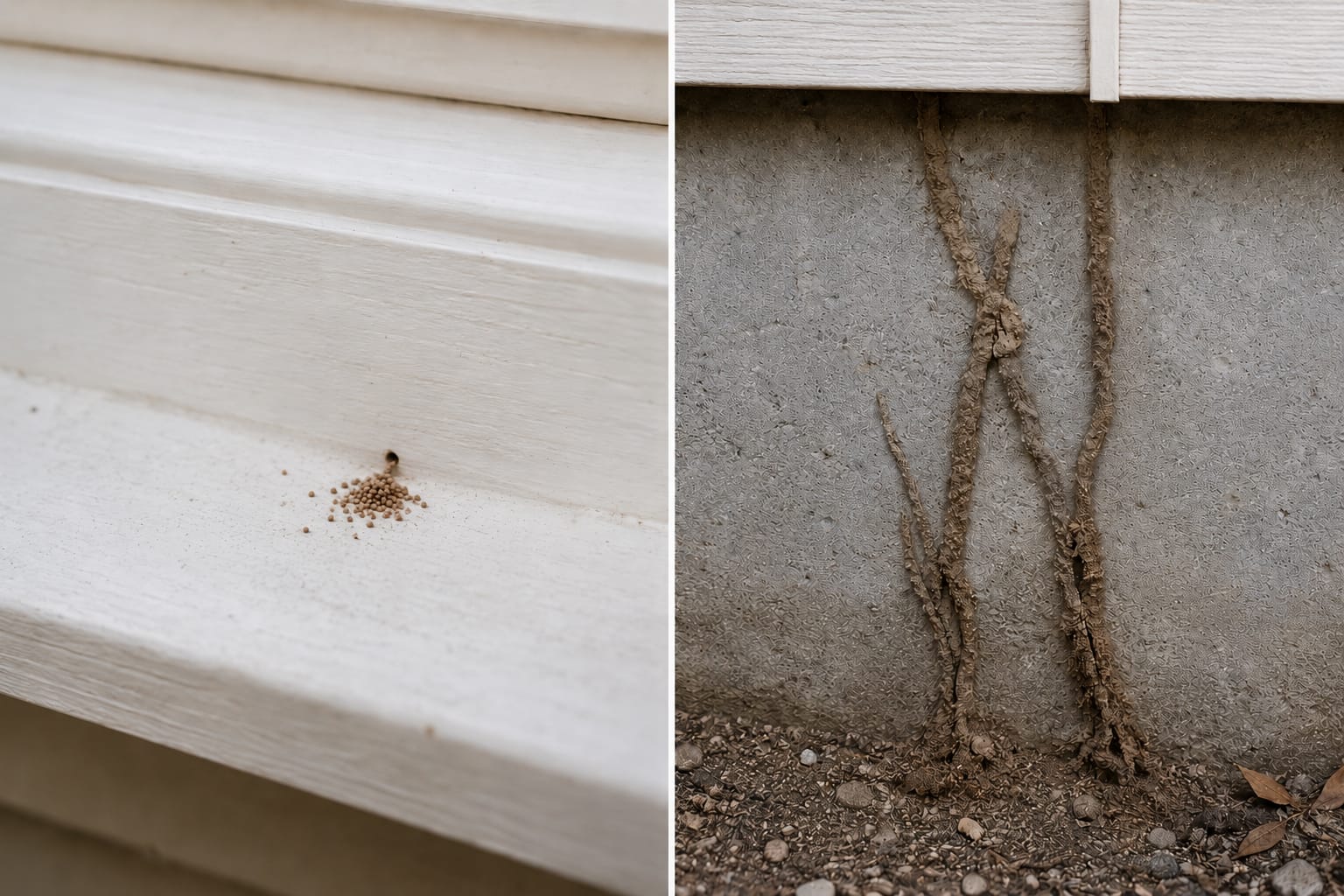
- Drywood termites live inside wood — no soil needed. Subterranean termites live underground and access wood from below.
- Frass (pellet droppings) means drywood. Mud tubes mean subterranean. Both can exist in the same structure simultaneously.
- Drywood termites are slower — colonies take years to develop. Subterranean colonies can consume wood faster once established.
- Treatment for one species doesn't work for the other — getting the diagnosis right first is essential.
- Most SoCal homes will encounter drywood termites during their lifespan. Subterranean termites are common near soil-to-wood contact and moisture.
- A properly licensed Branch 3 structural pest control company is required by California law to perform termite inspections and issue reports.
The core biological difference
The Biological Difference That Changes Everything
The single most important difference between these two species is where they live — and it drives everything else.
Drywood termites live entirely inside the wood they're infesting. The colony — including workers, soldiers, reproductives, and the queen — is contained within the wood structure itself. They don't need soil contact, they don't need external moisture beyond what's present in the wood, and they don't travel between the wood and the ground. A colony can establish in a second-floor window frame, in a piece of attic framing that never touches anything but air, in an antique piece of furniture, or in any exposed wood anywhere in or on the structure.
This has a practical consequence: they're essentially undetectable without finding their evidence or doing an invasive inspection. They don't build visible external structures. They can work inside a wall stud or rafter for years without producing any surface evidence except the occasional frass ejection.
Subterranean termites live underground. Their colony — which can contain hundreds of thousands to millions of workers — is based in the soil, typically at depths of several feet. Workers travel from the colony to wood food sources above, requiring either direct soil-to-wood contact or the construction of mud tubes that allow them to cross inhospitable surfaces while maintaining the humidity they need. When they finish feeding in an area, they retreat back underground.
The underground colony structure means that even an extensive subterranean termite infestation in a structure's framing may be supported by a colony entirely outside the structure — in the adjacent soil, under the slab, or in a neighboring property. Treating the wood itself without addressing the colony below often provides only temporary relief.
Drywood
Lives inside wood
No soil contact required. Slow-moving. Can go undetected for years. Prevalent across all of coastal and southern California.
Subterranean
Lives underground
Accesses wood through soil contact or mud tubes. Western subterranean colonies can number in the hundreds of thousands and feed continuously — capable of faster structural damage than drywood.
2–5 yrs
Colony age before swarming
A colony must be at least two to five years old before producing swarmers. Swarmers mean an established colony has been feeding for years.
Both
Can exist simultaneously
Many SoCal homes have both drywood and subterranean termite activity in different areas of the structure at the same time.
Evidence each species leaves
The Evidence Each Species Leaves
Learning to read what each species leaves behind is the most practical skill a homeowner can develop for early detection — because it's the information a licensed inspector uses to determine what you're dealing with before doing any invasive work.
Drywood termite signs
Frass.
The most reliable sign. Drywood termites push their fecal pellets out of small kick-out holes (less than 2mm in diameter) in infested wood. The pellets accumulate in small piles on horizontal surfaces below the source — window ledges, floors, tops of door frames, and any flat surface below exposed wood. Under magnification, each pellet is oval-shaped with six flattened sides and lengthwise ridges. Color ranges from light tan to dark brown depending on the wood being consumed.
Kick-out holes.
Tiny, clean-edged circular or oval holes less than 2mm in diameter in the surface of infested wood. These are the openings through which frass is ejected. They may appear singly or in clusters on baseboards, door frames, window sills, exposed beams, or attic framing.
Swarmers and discarded wings (fall).
Drywood termites swarm in Southern California from late summer through fall — September through November is peak swarming period for most coastal communities. Discarded wings found near windows, along door tracks, or inside the home after a warm afternoon indicate a swarming event from a nearby mature colony.
No soil evidence.
The absence of mud tubes and soil disturbance is itself a sign — drywood termites leave wood evidence without any ground-level indication.
Subterranean termite signs
Mud tubes.
The definitive sign. Pencil-width earthen tubes constructed from soil, frass, and wood particles, running along foundation walls, concrete piers, wooden posts, brick surfaces, or any material between the soil and the wood. They maintain the temperature and humidity workers need while traveling exposed surfaces. Active tubes are solid and intact — if a section is broken and repaired within a few days, the colony is still active.
Soil disturbance near the foundation.
Subterranean termites move significant amounts of soil as they construct galleries and tubes. Around the foundation, in crawl spaces, and in subareas, disturbed soil patterns or soil packed into cracks in concrete are indicators of activity.
Swarmers and discarded wings (spring).
Subterranean termites swarm primarily in late winter and spring in California — typically following rain events when humidity rises and temperatures warm. The timing difference from drywood swarmers (fall vs. spring) is itself a diagnostic indicator.
Hollow-sounding or damaged wood at floor level.
Subterranean termites typically consume wood from the ground up — floor joists, sill plates, cripple studs, and subfloor sheathing are their primary targets. Hollow-sounding wood concentrated at or below floor level, particularly near moisture areas, is a strong indicator.
Where each species is found
Where Each Species Is Found in SoCal Structures
Drywood termites can be anywhere in the structure that has exposed or accessible wood — attic framing, window and door frames, exterior wood trim, wood siding, interior furniture, garage framing. They don't favor any particular part of the structure based on moisture or soil proximity. A drywood colony can establish equally in a ground-floor baseboard or a second-floor attic rafter.
Subterranean termites concentrate their activity in areas near or below soil level: sill plates, cripple studs in the subarea, floor joists, any wood-to-soil contact points on the property, and areas with moisture — subterranean termites are drawn to wood that's been softened by water, so bathrooms with slow leaks, areas of irrigation over-spray, and any location where water consistently contacts structural wood are higher-risk zones. They're rarely found in attics or upper floors except in cases of severe, long-standing infestations.
Treatment differences
Treatment — Why One Approach Doesn't Fit Both
This is the critical practical implication of getting the species identification right. The treatments are fundamentally different and non-interchangeable.
Drywood termite treatment options
Localized spot treatment.
For small, accessible, well-defined infestations, drilling and treating individual members — injecting an insecticide or desiccant dust directly into the galleries — is appropriate. This is the least invasive approach and is suitable when the infestation is clearly limited to specific, identifiable areas. Requires drilling small holes into infested wood, treating the galleries, and patching the holes.
Whole-structure fumigation ("tenting").
When infestations are widespread, inaccessible, or multiple-location, fumigation is the standard of care. The structure is enclosed in tarps and a structural fumigant is released inside at lethal concentrations, penetrating all wood throughout the structure. The gas disperses and the structure is cleared for re-entry within 24 to 72 hours. Fumigation eliminates the entire drywood termite population regardless of where individual colonies are located — it's the only approach that addresses the whole structure simultaneously. Note: fumigation is not preventive — it eliminates existing colonies but creates no residual protection against new swarmers.
Subterranean termite treatment options
Liquid soil termiticide.
Applying a liquid termiticide to the soil around and under the foundation creates a chemical barrier that kills workers as they travel between the colony and the wood. Modern non-repellent termiticides (primarily fipronil or imidacloprid) are transferred between workers, meaning treated workers bring the active ingredient back to the colony. This requires drilling through concrete slabs in multiple locations and treating all soil contact points.
Termite baiting systems.
Bait stations installed in the soil around the structure attract foraging workers, who consume slow-acting bait and carry it back to the colony. Over weeks to months, the bait spreads through the colony and crashes the population. Baiting systems require regular monitoring and station maintenance — typically quarterly visits.
Combination approaches.
Active infestations with visible structural damage sometimes call for both localized wood treatment and soil treatment. This is particularly common with infestations that have been present for some time.
The California licensing context
The California Licensing Context
In California, termite inspections and treatments are regulated by the California Structural Pest Control Board (SPCB). There are three license branches: Branch 1 covers fumigation; Branch 2 covers general pest control; Branch 3 covers wood-destroying organisms including termites.
Termite inspections and treatments specifically require Branch 3 licensure. Before hiring any company for termite work, verify their SPCB license and ask specifically about Branch 3 coverage. A company licensed only for general pest control (Branch 2) cannot legally perform termite work in California.
After any inspection, California law requires the inspector to issue a standardized Wood Destroying Organisms (WDO) report — a formal document that identifies active infestations, evidence of prior infestation, and conducive conditions. A WDO report that says "termites" without specifying species, location, or distinguishing drywood from subterranean is incomplete. A legitimate SPCB-licensed inspection produces a document specific enough that a different inspector could read it and know exactly what was found and where.
Al & Sons holds Branch 3 licensing through SPCB
We've been conducting termite inspections across the South Bay and greater Los Angeles since 1960. Whether you've found frass, seen mud tubes, had swarmers appear in the house, or just haven't had an inspection in a few years, we're happy to come out and give you a clear picture of what's present and what it means.
Can a home have both?
Can a Home Have Both?
Yes — and it's more common than most homeowners realize. A 40-year-old home in Southern California with wood-framed construction has had decades to accumulate multiple termite introductions. A subterranean colony in the subarea and a drywood colony in the attic are not mutually exclusive. In fact, an inspection that finds evidence of only one species in an older home is sometimes incomplete — good inspectors check the full structure, not just the area where the first evidence is found.
When both species are present, treatment is more complex because the approach differs for each. Fumigation addresses the drywood population but does nothing for the underground subterranean colony. Soil treatment addresses the subterranean colony but leaves the drywood colony untouched. A comprehensive treatment plan for a dual infestation addresses both — typically fumigation for drywood combined with soil treatment or baiting for subterranean, with the sequencing determined by what's active and where.
The homeowner's termite action plan
Start with an inspection from a licensed Branch 3 operator Don't try to self-diagnose from what you find. Get a formal WDO report that specifies species, location, and treatment recommendation.
Read the report carefully It should identify which species, where activity was found, what evidence was observed, and what the treatment recommendation is. Vague reports ("evidence of termites, treatment recommended") are not sufficient.
Ask about the warranty Drywood spot treatments typically carry one to two year warranties. Fumigation warranties are usually one year. Subterranean baiting systems come with annual monitoring agreements. Soil termiticide warranties vary between five and ten years.
Don't let financial pressure push you toward inadequate treatment Spot treatment on a widespread drywood infestation that warrants fumigation, or baiting alone on a severe active subterranean infestation, both fail to fully address the problem. Get the right treatment for the species and extent of infestation.
Common questions
Drywood vs. Subterranean FAQs
Common questions from Southern California homeowners about termite species identification and treatment.
Q
Which type of termite is more common in Southern California?
A
Drywood termites are more broadly prevalent across coastal and southern California — they don't require soil moisture, and the entire region is within their range. Western subterranean termites are also present throughout the LA basin but concentrate more in areas with soil moisture, wood-to-soil contact, and older construction with accessible foundation wood. Both species are common enough that a comprehensive inspection of any older SoCal home is likely to find evidence of one or both.
Q
Is fumigation always necessary for drywood termites?
A
Not always. Localized spot treatment is appropriate for small, clearly bounded infestations where the extent of the colony is well-defined and accessible. Fumigation is warranted when infestations are widespread across multiple areas of the structure, when they're in inaccessible locations, or when multiple separate colonies are present. The deciding factor is the extent and accessibility of the infestation — which is why the inspection and WDO report are the essential first step before any treatment decision.
Q
How long does it take for termites to cause serious structural damage?
A
It depends on the species. A single drywood termite colony is relatively slow-moving — serious structural damage from a single colony can take a decade or more, though multiple colonies in different parts of the structure accelerate the cumulative damage. Subterranean termites, supported by underground colonies that can contain hundreds of thousands of workers, can cause meaningful structural damage in two to five years under favorable conditions. Neither species causes immediate catastrophic damage — which is why the "catch it early" recommendation is about cost management, not emergency response.
Q
My neighbor just had their house tented. Does that mean my house has termites too?
A
Not necessarily, but it raises a question worth investigating. Drywood termites swarm and spread to adjacent structures — a neighbor's fumigation doesn't mean your house is infested, but if the neighboring colony was mature enough to produce swarmers in the last several years, some of those swarmers may have established in your structure. If your house hasn't had a termite inspection in the last two years and a neighbor has had active drywood termites, scheduling an inspection is a reasonable precaution.
Q
Can I treat termites myself?
A
The treatments that actually work aren't available to unlicensed homeowners, and the treatments that are available to homeowners don't work reliably against established infestations. For subterranean termites, retail baiting products can reduce activity at individual stations but don't provide colony-wide management. For drywood termites, spot treatment requires drilling into structural wood — which requires knowing where the galleries are and using appropriate products. Fumigation is an entirely regulated process requiring licensure. The right call for any suspected termite activity is a licensed Branch 3 inspection.
Related Reading
- 7 signs you have termites — and what each one meansA detailed guide to reading the evidence.
- Why isn't my pest control working? 7 reasons treatments failWhen the treatment doesn't match the problem, it fails — exactly the risk with a misdiagnosed termite species.
- Our termite control serviceInspection, treatment, and ongoing protection for SoCal homes.
- Drywood termite pest libraryIdentification, biology, and lifecycle.
- Subterranean termite pest libraryIdentification, biology, and lifecycle.
- Termites pest libraryThe full termite category for SoCal homeowners.
SP
About the Author
Sydney Pardey·Owner, Al & Sons Termite and Pest Control
SPCB Field Representative License No. FR 72134SPCB Company License No. 10102
Sydney Pardey is the owner of Al & Sons Termite and Pest Control, a family-owned pest control company serving the South Bay and greater Los Angeles area since 1960. All content is written from direct operational experience and reviewed against current California Structural Pest Control Board standards.
Our LegacyServing Southern California
Serving Southern California
Since 1960.
Al & Sons is more than a business—it's a family legacy. For over 60 years, we've been local neighbors, committed to serving our community across Southern California with the same integrity and care when the business was started in 1960.
100%
Family Owned
SoCal
Local & Dedicated