Service Guide • June 22, 2026
How Long Does Pest Control Take to Work?
The honest answer by species — and why the most common reason people think pest control failed is that they quit too early or switched approaches too fast.
SP
Sydney Pardey
Owner, Al & Sons Termite and Pest Control
7 min readUpdated June 22, 2026
Pest ControlService GuideTreatment TimelinesSoCal Homeowner
It's one of the most common calls pest control companies get: "I had a service a week ago and I'm still seeing pests. Is something wrong?" Sometimes something is wrong. More often, nothing is wrong — the treatment is working exactly as it should, and the homeowner just didn't know what to expect or how long to wait.
Pest control doesn't work the way most people assume. It's not a switch that flips — treat on Tuesday, no pests by Friday. Different species respond to different methods at different speeds, and the window between "treatment applied" and "problem resolved" varies from a few days to several weeks depending on what's being treated and how established the population was. Understanding the real timelines, species by species, is the difference between a homeowner who sticks with the right protocol and gets results, and one who panics at week two and resets the clock on what was already working.
Quick Answer
How long does pest control take to work?
It depends entirely on the species and the treatment method. Argentine ant bait programs take two to three weeks — you'll see more ants at first as they feed on the bait. German cockroach gel bait takes three to four weeks to crash an established population. Roof rat control plays out over several weeks after exclusion work is complete. Subterranean termite baiting takes three to six months to eliminate a colony. Perimeter spray treatments for general insects should be reapplied every one to two months to maintain residual protection. The single most common reason pest control appears to fail is that homeowners expect results before the treatment has had time to work.
The Short Version
- There is no universal timeline — every species has a different biological response to treatment.
- Bait-based treatments are slow by design — the delayed action is what allows bait to spread through colonies.
- Seeing more pests immediately after treatment is often a sign the treatment is working, not failing.
- Perimeter spray treatments need to be reapplied every one to two months to maintain effective residual protection.
- Some treatments (termite baiting, rodent exclusion) play out over months, not weeks.
- If a treatment isn't trending in the right direction after the expected window, call your provider — don't switch approaches on your own.
Why timelines vary
Why Pest Control Has Different Timelines for Different Species
The core reason timelines vary so much is that professional pest control doesn't work the same way across species. Some treatments kill on contact — the pest touches the treated surface and dies relatively quickly. Others are slow-acting by design — the pest eats the bait, survives long enough to carry it back to the colony and share it with others, and the active ingredient spreads through the population before it takes effect. Still others are preventive barriers — they don't kill existing pests but stop new ones from entering while the existing population declines.
Matching your expectations to the treatment your provider used is the single most important piece of information in this article. If you're waiting for overnight results from a bait program, you'll be disappointed — and if you respond to that disappointment by adding a competing product, you'll interfere with the professional treatment and reset the timeline.
Argentine ants
Argentine Ants — 2 to 3 Weeks
Argentine ant control using professional bait programs is deliberately slow. The bait needs to remain active long enough for workers to carry it back to the colony and share it through trophallaxis with the queens and other workers. If the active ingredient worked too quickly, workers would die before reaching the nest and the colony would remain intact.
What to expect in week one: activity at the bait placement point often increases in the first three to five days. Workers are actively feeding and recruiting more workers to the bait source — this is exactly what a working bait program looks like. This is the phase when homeowners are most likely to assume the treatment isn't working. It is.
What to expect in week two: trail activity should begin to noticeably decline. The colony is starting to feel the effects as the active ingredient has been distributed to enough workers and queens.
What to expect in week three: significant reduction in visible trail activity. Some residual foragers may still appear along previously established trails, but numbers should be a fraction of the peak.
The most important thing during this period: don't apply any contact spray or competing product anywhere ants are trailing or where bait has been placed. Repellent products disrupt bait-taking behavior and can trigger colony budding — making the problem worse rather than better. If you're concerned about progress, call your provider rather than adding your own treatment.
Perimeter spray treatments work on a different timeline — products contact and kill workers immediately but need reapplication every one to two months to maintain residual barrier effectiveness as the product naturally degrades.
German cockroaches
German Cockroaches — 3 to 4 Weeks
German cockroaches respond well to correctly applied professional gel bait. The same slow-acting mechanism applies — the bait needs to reach the queens in harborage zones, which happens through food sharing among workers and nymphs over several weeks.
What to expect in week one: bait placement often draws cockroaches out of harborage and into visible areas as they locate and begin feeding on the bait. This is almost universally misread as the treatment not working. A homeowner who sees cockroaches out in the open more frequently in the first week is actually seeing a positive sign — the population is engaging with the bait.
What to expect in weeks two to three: the visible population should noticeably decrease. Live sightings become less frequent. You may start seeing dead or dying cockroaches. This is the population collapsing.
What to expect in week four: activity should be dramatically reduced. Some residual sightings may continue as the last individuals from the population are affected.
For larger or longer-established populations: a heavy infestation can take six to eight weeks. The program needs time to work through the full population. If visible activity hasn't begun to decline after four weeks, contact your provider — there may be harborage zones that weren't reached in the initial treatment.
The most common disruption to cockroach treatment
Consumer aerosol sprays or foggers applied in areas where professional gel bait has been placed contaminate the bait and make it unpalatable. The cockroaches retreat, the bait goes untouched, and the population continues to breed. If cockroach bait has been placed in your home, don't apply any competing product — call your provider if you have concerns.
Roof rats
Roof Rats — Multi-Stage Process
Roof rat control plays out in two sequential phases, and the timeline for each matters separately.
Exclusion phase: before trapping begins, every entry point on the structure needs to be sealed. This phase involves real physical work — ladder work on the roof, hardware cloth installation, flashing repairs — and its duration depends on how many entry points are found and how accessible they are.
Trapping phase: once sealed, snap traps inside the structure begin removing the existing population. Catch rates are typically highest in the first several days — established travel routes mean rats encounter traps quickly. Catches taper as the population is removed.
Verification: traps remain in place until empty for a sustained period with no new activity sounds, at which point the active service phase is complete.
If catches continue beyond what's expected: this is the diagnostic signal that an entry point was missed. The technician needs to go back to the roof, not simply continue trapping.
Subterranean termites
Subterranean Termites — Months, Not Weeks
This is the treatment category where homeowner expectations are most dramatically misaligned with biological reality. Subterranean termite control operates on a timeline of months.
Liquid soil treatments: modern non-repellent termiticide products create a treated zone in the soil that workers carry back to the colony through contact transfer. Colony elimination can take 30 to 90 days. Activity in the treated structure may continue during this period as the colony's population declines.
Termite baiting systems: the slowest and most gradual approach — but highly effective when maintained correctly. Workers find bait stations, consume the bait, share it through trophallaxis, and the colony declines over months. Full colony elimination through a baiting program typically takes three to six months. This is not a sign of failure — it's the biological mechanism of the approach.
What to monitor: not whether termites are still present immediately after treatment, but whether the activity indicators are trending downward over the treatment period.
Drywood termites
Drywood Termites — Variable by Treatment Method
Fumigation is the fastest resolution for widespread drywood infestations. Once the structure is tented, the fumigant penetrates all wood in the structure within 24 to 48 hours. Post-aeration and clearance take another 24 hours. The entire drywood termite population within the structure is eliminated — there is no waiting period with fumigation.
Spot treatment has a slower and less certain timeline. The insecticide or desiccant dust is applied to the galleries of identified colonies, and colony mortality happens over one to several weeks as the product reaches the queen. For well-defined, accessible, small colonies, this is effective. For colonies that extend into inaccessible areas, the treatment may need to be followed up.
Fleas
Fleas — 3 to 6 Weeks, With Multiple Treatments
Flea control is frustrating specifically because of the flea life cycle. Adult fleas on a pet are the visible minority of the infestation — the eggs, larvae, and pupae in carpet, furniture, and yard soil represent the majority of the population, and they're not immediately affected by most professional treatments.
Professional interior treatment uses insecticide combined with insect growth regulator (IGR) applied to carpets and upholstery. The IGR prevents larvae and pupae from maturing into adults. But existing pupae in protective cocoon stage continue to emerge for two to four weeks after treatment as they naturally complete their development cycle.
The critical insight: seeing fleas for two to four weeks after professional treatment is not a failure — it's the existing pupae completing their cycle. The treatment has stopped new eggs from developing, but the existing pupae in the environment are unaffected until they emerge. The cycle ends when all existing pupae have emerged and the growth regulator has prevented new eggs from developing.
What's required for success: simultaneous professional treatment of the indoor environment, the outdoor yard if the pet goes outside, and veterinary-grade flea prevention for the pet. Treating any one element without the others leaves the reinfestation cycle intact.
Perimeter treatment
General Perimeter Treatment — Every 1 to 2 Months
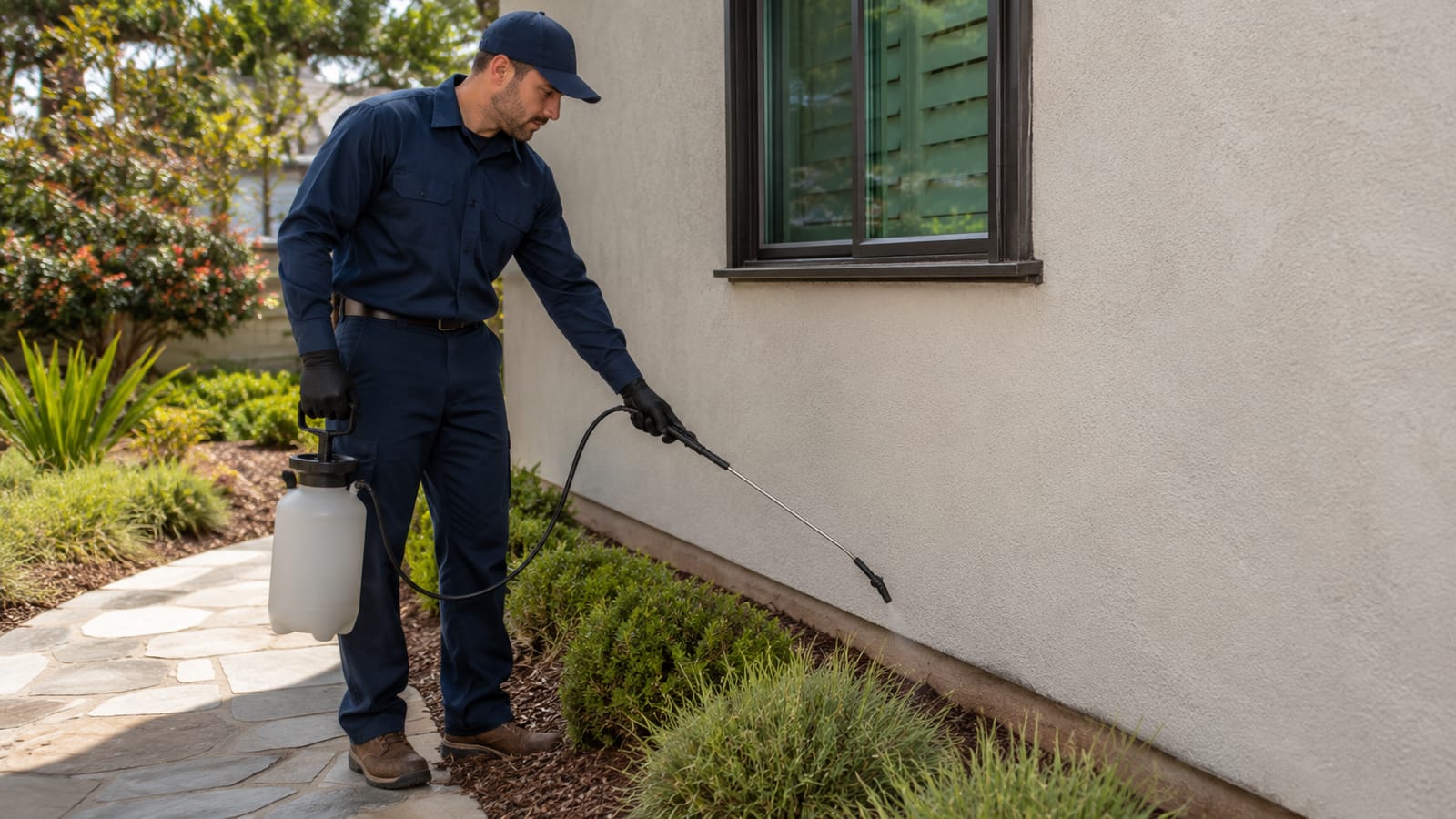
A professional perimeter treatment applied around the foundation, along the roofline, and at entry points works fastest against active pests that contact the treated zone directly. Ants, spiders, crickets, and other occasional invaders that cross the treatment zone are affected quickly — within hours to a day or two of contact.
However, residual products naturally degrade over time from UV exposure, weather, and normal environmental conditions. For a perimeter barrier to maintain its effectiveness, reapplication every one to two months is the standard — not once per quarter. Gaps in treatment allow pest pressure to rebuild between visits, which is one of the most common reasons homeowners feel like their service isn't holding.
Seasonal timing also matters: a perimeter treatment applied before peak summer pest season holds better than a reactive treatment applied during it. Getting ahead of the pressure is more effective than catching up to it.
2–3 wks
Argentine ant bait programs
Activity typically increases in week one as workers feed on bait — this is the treatment working.
3–4 wks
German cockroach gel bait
Visible population decline begins in weeks two to three. Larger populations can take six to eight weeks.
3–6 mos
Subterranean termite baiting
Colony elimination through baiting takes months — not weeks. Liquid soil treatments work faster at 30 to 90 days.
1–2 mos
Perimeter spray reapplication
Professional perimeter treatments need reapplication every one to two months to maintain residual barrier effectiveness.
How to evaluate progress
How to Evaluate Whether Treatment Is Working
Don't evaluate at week one
Ask instead whether activity is trending in the right direction. For bait-based treatments, expect more activity at first. For barrier treatments, expect some continued indoor activity for a period.
Document what you're seeing
Note where you saw activity, how many, and the date. This is more useful than general impressions and helps your provider track the trend accurately over visits.
Give bait programs the full window before evaluating
The mechanism requires time. Contacting your provider at day seven is fine — but evaluating whether the program has failed at that point is premature.
Don't add competing products
Adding your own spray to a professional bait program almost always disrupts the approach. If you're uncertain whether treatment is working, call your provider and ask.
Know when to call back
Some continued activity within the expected timeline is normal. Activity that hasn't declined at all after the expected window, or a sharp increase well after treatment should have taken hold, warrants a call to your provider.
Wondering why pests are still showing up after your last service?
Al & Sons has been diagnosing pest control results — and fixing them when something went wrong — across the South Bay and greater Los Angeles since 1960. If you had a service and aren't seeing results on the expected timeline, we're happy to take a look, identify what's happening, and tell you honestly whether it's a timing question or something that needs to be addressed differently.
Common questions
Pest Control Timeline FAQs
Common questions from Southern California homeowners about how long pest control takes.
Q
I had a pest control service three days ago and I'm still seeing ants. Did it fail?
A
Almost certainly not — three days is far too early to evaluate a professional bait program. If sugar-based liquid bait was placed, activity at the bait placement may have increased in the first few days as workers recruit heavily to the food source. This is the bait working, not failing. Give the protocol two to three full weeks before drawing any conclusions, and don't apply any spray products in the meantime — call your provider if you're concerned.
Q
How do I know if the pest control company used the right treatment?
A
Ask directly. A legitimate operator should be able to tell you: what species they identified, what approach they used and why it's right for that species, what to expect over the next two to four weeks, and when to contact them if activity isn't declining. If the answers are vague — "we sprayed around the perimeter, it should be fine" — that's a signal the treatment may not have been diagnostic.
Q
My pest control service was six months ago and the pests are back. Is that normal?
A
It depends on what was treated and what service interval was agreed to. Perimeter spray treatments need reapplication every one to two months to maintain their residual effectiveness — a single treatment from six months ago has long since degraded. If you were set up for recurring service and scheduled visits didn't happen, the treatment lapsed. Consistent, properly-spaced service is what maintains suppression over time.
Q
What's the fastest pest control fix?
A
For stinging insects (wasp or bee nest removal), same-day resolution is achievable and common. Fumigation for drywood termites provides the fastest colony elimination — 48 to 72 hours from tenting to clearance, with immediate colony death. For ants and cockroaches, the biologically correct approach requires weeks — bait programs are slow by design because that's what makes them work. Any service promising overnight results for ants or cockroaches is not using the right approach.
Q
Should I clean up dead bugs after treatment, or leave them?
A
A few dead insects visible after treatment are fine to leave for a short period — they can serve as secondary indicators that the treatment is working. Leaving large accumulations for extended periods isn't necessary. The general guidance: leave treated areas undisturbed for the first 24 to 48 hours, then clean up visible debris normally. Don't deep-clean with strong chemical products in areas where bait has been placed — you'll destroy the bait and disrupt the program.
Related Reading
- Why isn't my pest control working? 7 reasons treatments failThe full breakdown of what goes wrong and why.
- How to get rid of ants in the house — what actually works in SoCalArgentine ant treatment timelines explained.
- German cockroaches vs. American cockroachesWhy species identification determines treatment timeline.
- Our general pest control serviceWhat to expect from recurring perimeter treatment.
- Ants pest libraryArgentine ant biology and behavior.
- Cockroaches pest libraryGerman cockroach biology and treatment.
SP
About the Author
Sydney Pardey·Owner, Al & Sons Termite and Pest Control
SPCB Field Representative License No. FR 72134SPCB Company License No. 10102
Sydney Pardey is the owner of Al & Sons Termite and Pest Control, a family-owned pest control company serving the South Bay and greater Los Angeles area since 1960. All content is written from direct operational experience and reviewed against current California Structural Pest Control Board standards.
Our LegacyServing Southern California
Serving Southern California
Since 1960.
Al & Sons is more than a business—it's a family legacy. For over 60 years, we've been local neighbors, committed to serving our community across Southern California with the same integrity and care when the business was started in 1960.
100%
Family Owned
SoCal
Local & Dedicated