Pest ID • June 17, 2026
Where Black Widows Hide in SoCal Homes — and How to Find Them
A practical, location-by-location guide to where Southern California's most venomous spider actually lives — and why professional treatment is the right call for any home with black widow activity.
SP
Sydney Pardey
Owner, Al & Sons Termite and Pest Control
8 min readUpdated June 17, 2026
SpidersBlack WidowsPest IDSoCal Homeowner
The western black widow is one of the few pests in Southern California that genuinely deserves the caution it gets. Most spiders homeowners encounter are harmless — house spiders, cellar spiders, jumping spiders, orb weavers — and the reflexive panic they trigger is disproportionate to the actual risk. Black widows are the exception. Their venom is medically significant, their populations across coastal and inland SoCal are substantial, and the spaces where they prefer to live are exactly the spaces homeowners and children regularly reach into without thinking.
The good news is that black widows are predictable. They consistently choose specific kinds of locations, follow specific seasonal patterns, and leave specific signs of their presence. Knowing where they tend to concentrate on a typical Southern California property helps you understand where to be cautious — and why any sign of black widow activity warrants a call to a professional rather than a DIY response.
Quick Answer
Where do black widows hide in Southern California homes?
Black widows prefer undisturbed, dark, dry, ground-level locations with structural cover. The most common spots on SoCal properties are garages (especially in clutter, woodpiles, and corner shelving), under and inside outdoor furniture (cushion storage boxes, hollow furniture legs, the underside of patio chairs), in dense landscaping (ivy, ground cover, under decking, in irrigation valve boxes), around pool equipment and outdoor storage, and in low-traffic interior spaces like rarely-used closets and storage areas. Late summer through fall (August through October) is peak black widow season. Importantly, a single visible web or spider almost always means more are present in nearby harborage — professional treatment is the appropriate response to any black widow sighting.
The Short Version
- Black widows are the only medically significant spider species most SoCal homeowners encounter regularly.
- They consistently choose dark, undisturbed, ground-level locations with structural cover.
- The garage is the single highest-risk space on most SoCal properties.
- Outdoor furniture, pool equipment, irrigation valve boxes, and dense landscaping are all common harborage areas.
- If you see one black widow, there are almost certainly more in nearby undisturbed areas.
- Late summer through fall is peak season — the worst time for accidental encounters.
- Any black widow activity warrants professional treatment, not a DIY approach.
What to look for
What You're Actually Looking For
Before walking through locations, it's worth being clear about how to recognize black widow activity — because knowing the signs helps you understand when to call for professional help.
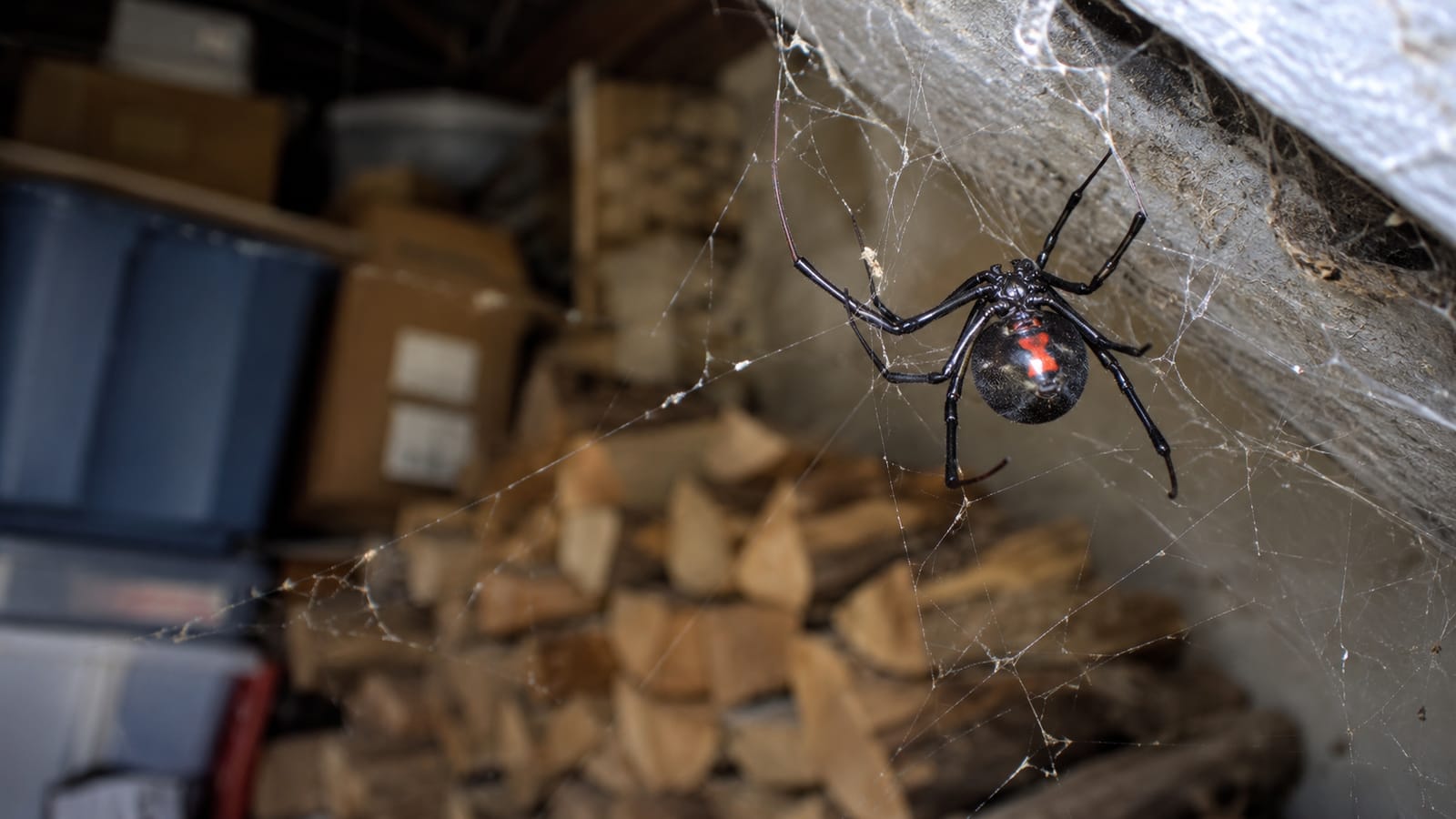
The adult female western black widow is the dangerous one. She's about half an inch in body length (closer to an inch including legs), shiny jet-black, with a distinctive red or orange hourglass marking on the underside of her abdomen. The hourglass can be a solid shape or two separated triangles, and the color ranges from bright red to dull orange depending on age and recent molting. The body is round and bulbous — she looks heavy and substantial, not like a typical wispy house spider.
Adult males and juveniles look very different from females and are not medically significant. Males are smaller (about a quarter inch), brown or tan with light cream markings, and have longer legs relative to their bodies. Juvenile females start out cream-colored with darker striping and gradually darken with each molt over several months, only achieving the classic jet-black adult appearance after their final molt.
The web is often more recognizable than the spider. Black widow webs are irregular, asymmetric, three-dimensional tangles — not the geometric circular webs of orb weavers or the flat sheets of house spiders. The silk is exceptionally strong and produces a distinct snapping sound when broken, which is one of the most reliable identifiers. Webs are typically built in corners, between objects, or in the recess of small openings, and they often look dirty — accumulated debris and dust collected in the strong silk.
Egg sacs are another reliable indicator. They're round to slightly elongated, about half an inch across, papery in texture, and pale tan to cream-colored. Each sac contains 100 to 400 eggs, and a single female can produce four or more sacs in a season. Finding egg sacs in any of the areas below is a clear signal that professional treatment is needed.
One sighting means more are present
If you see a single black widow web or spider, it almost certainly doesn't mean you have just one. Black widows establish in harborage zones — and where conditions are right for one, they're typically right for more in adjacent undisturbed areas. A visible spider is the part of the population you happen to see. Professional treatment addresses the harborage zones where the rest are.
Garage
Garage — The Single Highest-Risk Space
The garage combines virtually every condition black widows look for: structural cover, low traffic, dry conditions, dim light, and significant clutter that creates microhabitat. On most Southern California properties, it's the space with the highest likelihood of black widow activity — and where accidental encounters most commonly happen.
Corner shelving and stored items.
Where two walls meet, where a shelf meets a wall, and where stored boxes have been sitting undisturbed for months — these are prime web-building locations. Webs typically accumulate visible debris over time and are most visible under direct light. Be cautious whenever reaching into corner shelving areas, particularly lower shelves.
Woodpiles.
Stored firewood is among the highest-risk locations for black widows anywhere on a SoCal property. The spaces between individual logs provide ideal harborage. Always use caution and wear gloves when handling stored firewood — the underside of stacked logs is where spiders typically position themselves.
Garden tools, outdoor equipment, and rarely-used items.
Lawn mower undersides, leaf blower intakes, the inside of pruning tool handles, watering can handles — any infrequently-disturbed item in the garage is a potential habitat. Use caution when reaching around any item that hasn't been moved in a while.
Long-stored boxes.
Holiday decoration storage, old toy boxes, and stored equipment create exactly the kind of undisturbed corner environment black widows prefer. Be cautious whenever opening boxes that have been stored for an extended period.
Behind and underneath workbenches and cabinets.
The inside corners of metal cabinets, the space around garage door track mechanisms, and the area behind workbenches are all dim, dry, and rarely disturbed — exactly the conditions black widows seek.
Outdoor furniture and patio
Outdoor Furniture and Patio Areas
The areas around outdoor entertaining spaces are common black widow territory, particularly as summer progresses into late summer and fall when populations are at their peak.
Cushion storage boxes.
Among the most reliable black widow locations in residential settings. The lid corners, interior edges, and hinge areas of outdoor cushion storage containers create exactly the dark, enclosed harborage black widows use. These boxes are typically opened seasonally — meaning spiders can establish and grow undisturbed for months. Be cautious whenever opening any outdoor storage container that hasn't been opened recently.
Hollow furniture legs.
Many outdoor chairs, tables, and benches have open or loosely-capped leg bottoms. Black widows establish inside these cavities and build webs that extend out from the opening. Be aware of this when moving or reaching around outdoor furniture that's been in one spot for a while.
The underside of patio furniture.
The space between the bottom of a chair or table and the ground is a classic black widow location, particularly for furniture that doesn't move often. Be aware of this when handling outdoor furniture that has been undisturbed for several weeks.
Outdoor grills and cooking equipment.
The cabinet area, undercarriage, and covered compartments of grills can harbor black widows — particularly if equipment hasn't been moved recently. Be cautious around grill storage areas before reaching inside.
Awning frames, pergola structures, and outdoor lighting.
Where horizontal beams meet vertical posts, where shade sails attach to corner hardware, and where outdoor lighting is mounted to the wall are all areas worth being cautious around, particularly during late summer and fall.
Pool equipment and sheds
Pool Equipment, Sheds, and Outdoor Storage
Any outdoor utility or storage area on a Southern California property is likely black widow territory and should be approached with that awareness.
Pool equipment enclosures.
The space inside pump covers, around filter housings, behind heaters, in the corner of equipment pad walls, and inside access panels create dry, sheltered, rarely-disturbed harborage. Pool equipment is typically touched only during service, giving spiders long undisturbed periods to establish. Be cautious whenever opening or working around pool equipment.
Sheds and outbuildings.
Any tool shed, garden shed, or outdoor storage structure should be approached with black widow awareness — particularly the corners, undersides of shelves, and areas around stored items that don't get moved regularly.
Recycling bins and trash cans.
The underside of lids, upper interior corners, and the recess around wheel housings create harborage. Be cautious before reaching inside any outdoor bin.
Hose reels, irrigation control boxes, and utility access panels.
These are among the most consistent black widow locations in SoCal residential settings — dark, dry, rarely disturbed. Be particularly cautious before any maintenance work involving these areas.
Landscaping
Landscaping and Ground-Level Outdoor Areas
Some black widow habitat is part of the landscape itself. Being aware of where this habitat forms helps you stay cautious in the right areas and understand where professional treatment is most important.
Irrigation valve boxes.
Among the most consistent black widow habitats in suburban SoCal yards. The interior is dark, sheltered, structurally complex, and rarely disturbed. Always lift the lid carefully, and never reach into an irrigation box without first being aware of what might be inside.
Under decking and raised platforms.
The space under wood decking, raised garden beds, kids' play platforms, and any elevated outdoor structure provides ideal harborage. Being aware that these spaces exist is important, particularly if children play near or under such structures.
Dense ground cover and ivy.
English ivy, Algerian ivy, bougainvillea growing along fences, and similar dense plantings create essentially permanent black widow habitat. Be cautious when working in or around dense plantings adjacent to areas where people spend time.
Stone walls, rockwork, and retaining walls.
The spaces between stones and in the recesses of construction provide harborage. Any work involving moving or disturbing stonework should be done with black widow awareness and appropriate protective gear.
Under flowerpots and planters.
The underside of established planters is a reliable location for black widow web-building. Be aware of this before moving any planter that has been sitting in the same location for a period of time.
Inside the home
Inside the Home — Lower-Risk but Worth Knowing
Black widows are primarily outdoor and garage-associated, but they can occasionally establish indoors in specific types of low-traffic spaces. As with all black widow activity, any indoor sighting should be treated as a sign that more may be present in nearby undisturbed areas.
Rarely-used closets.
Coat closets that mostly hold seasonal items, linen closets in guest bathrooms, and storage closets in laundry rooms can develop populations if left undisturbed long enough. Be aware when going through long-undisturbed storage.
Behind and underneath heavy furniture against walls.
Large bookcases, entertainment centers, and similar furniture that doesn't move often can develop webs in the recess between the back of the furniture and the wall.
Inside infrequently-worn footwear stored in garage or mudroom areas.
This is a documented scenario for black widow encounters. Be cautious with footwear that's been stored in the garage or an outdoor mudroom area for any extended period.
Why professional treatment
Why Professional Treatment Is the Right Call for Black Widows
Any black widow activity on a property — a single web in the garage, an egg sac under a planter, a spider spotted near pool equipment — is a signal that professional treatment is warranted. Black widows don't tend to be isolated; where you see one, the conditions that support it typically support more in adjacent undisturbed areas.
The visible spider is not the whole population.
A web you can see in a garage corner represents an established harborage area. Removing one web or one visible spider doesn't address the harborage conditions that produced it or the other spiders in adjacent areas — it just removes the one you happened to find.
Egg sacs represent the next generation.
A single egg sac contains 100 to 400 eggs. Any property with egg sacs present has a population problem that extends well beyond the adult that produced them. Professional treatment addresses both the adults and the reproductive cycle.
Harborage zones need targeted treatment, not just web removal.
Effective black widow management means applying residual products to the specific corners, recesses, and structural areas where spiders establish. This requires knowing where those zones are on your specific property and having the right products to treat them — work a professional does systematically rather than reactively.
Peak season timing makes early treatment the most protective approach.
Late summer and fall — when black widow populations are at their highest in Southern California — is also when children are spending more time outdoors before the school year starts. Scheduling professional treatment before that window provides the most protection when it matters most.
Consumer spray products don't solve the problem.
Aerosol spider sprays applied to visible areas may kill individual spiders on contact but don't reach the harborage zones where the population is concentrated. Broadcast spraying can also push spiders to other areas of the property rather than reducing the overall population. Professional treatment with appropriate residual products applied to actual harborage locations produces reliably different results.
Any black widow sighting is a reason to call
Al & Sons has been treating black widow populations across the South Bay and greater Los Angeles since 1960. If you've spotted a web, an egg sac, or a live spider anywhere on your property — in the garage, around outdoor storage, near pool equipment, or anywhere your family spends time — that's a reason to call. One visible spider means more are present. We'll assess what's there across the property and treat the harborage zones properly so you're not dealing with what's hidden.
Common questions
Black Widow Detection FAQs
Common questions from Southern California homeowners about finding and identifying black widows.
Q
How do I know if a web is from a black widow or a regular house spider?
A
Black widow webs are irregular, asymmetric, three-dimensional tangles — not the flat geometric webs of orb weavers or the loose sheets of house spiders. The silk is exceptionally strong and produces a distinct snapping sound if a strand is broken. Webs are typically built in corners, between objects, or at the recess of small openings, and they often accumulate debris and look dirty over time. If you're seeing webs like this in any of the locations described in this article, treat it as potential black widow activity and contact a professional rather than disturbing the web yourself.
Q
I only saw one black widow — do I really need professional treatment?
A
Yes. A single visible black widow almost always means more are present in nearby undisturbed areas. Black widows establish in harborage zones — and where conditions are right for one, they're typically right for others in adjacent corners, cavities, and stored items. The spider you saw is the part of the population you happened to encounter, not necessarily the whole picture. Professional treatment addresses the harborage zones systematically, not just the individual spider you found.
Q
Is a brown widow as dangerous as a black widow?
A
Brown widows have established themselves across Southern California over the past two decades and are now common in residential settings. Their venom is chemically similar to black widow venom, but their bites typically produce milder symptoms — usually localized pain and swelling rather than the systemic symptoms black widow bites can cause. They're worth having professionally treated regardless. Adult female brown widows are lighter brown to tan with a striped or mottled pattern, and the hourglass on the underside is typically orange rather than red.
Q
What time of year are black widows most active in Southern California?
A
Population density peaks August through October — by late summer, juvenile spiders that hatched in spring have matured into adults, and adult females are most active in web maintenance and reproduction. This is when most bites happen in residential settings. Activity continues year-round in SoCal's mild climate, but the encounter risk drops in winter and rises through spring as juveniles disperse. Scheduling professional treatment in late spring or early summer — before peak season — is the most protective approach.
Q
Can I just spray the corners of my garage myself?
A
Consumer spider sprays are not an effective solution for black widows specifically. Aerosol products may kill an individual spider on contact but don't reach the harborage zones where the population is concentrated — inside cavities, behind stored items, in structural recesses. Broadcast spraying can push spiders to other areas rather than reducing the population. More importantly, applying spray near harborage zones disturbs spiders and increases the risk of an encounter during application. Professional treatment with appropriate residual products applied systematically to actual harborage locations produces reliably better results and eliminates the exposure risk of DIY application.
Related Reading
- Summer is coming — and so are the bugsThe full SoCal summer pest season guide, including late-summer black widow peak.
- Why your backyard is a bug magnetHow outdoor entertaining spaces create black widow habitat.
- Protecting your kids from pestsSpecific guidance on black widow risk in spaces children use.
- Our general pest control serviceRecurring perimeter and harborage treatment for South Bay homes.
- Black widow pest libraryIdentification, biology, and behavior.
- Spiders pest libraryThe full spider category for SoCal homeowners.
SP
About the Author
Sydney Pardey·Owner, Al & Sons Termite and Pest Control
SPCB Field Representative License No. FR 72134SPCB Company License No. 10102
Sydney Pardey is the owner of Al & Sons Termite and Pest Control, a family-owned pest control company serving the South Bay and greater Los Angeles area since 1960. All content is written from direct operational experience and reviewed against current California Structural Pest Control Board standards.
Our LegacyServing Southern California
Serving Southern California
Since 1960.
Al & Sons is more than a business—it's a family legacy. For over 60 years, we've been local neighbors, committed to serving our community across Southern California with the same integrity and care when the business was started in 1960.
100%
Family Owned
SoCal
Local & Dedicated